Red Bulls Host San Diego FC as EPA Sludge Plant Looms
Oct 07, 2026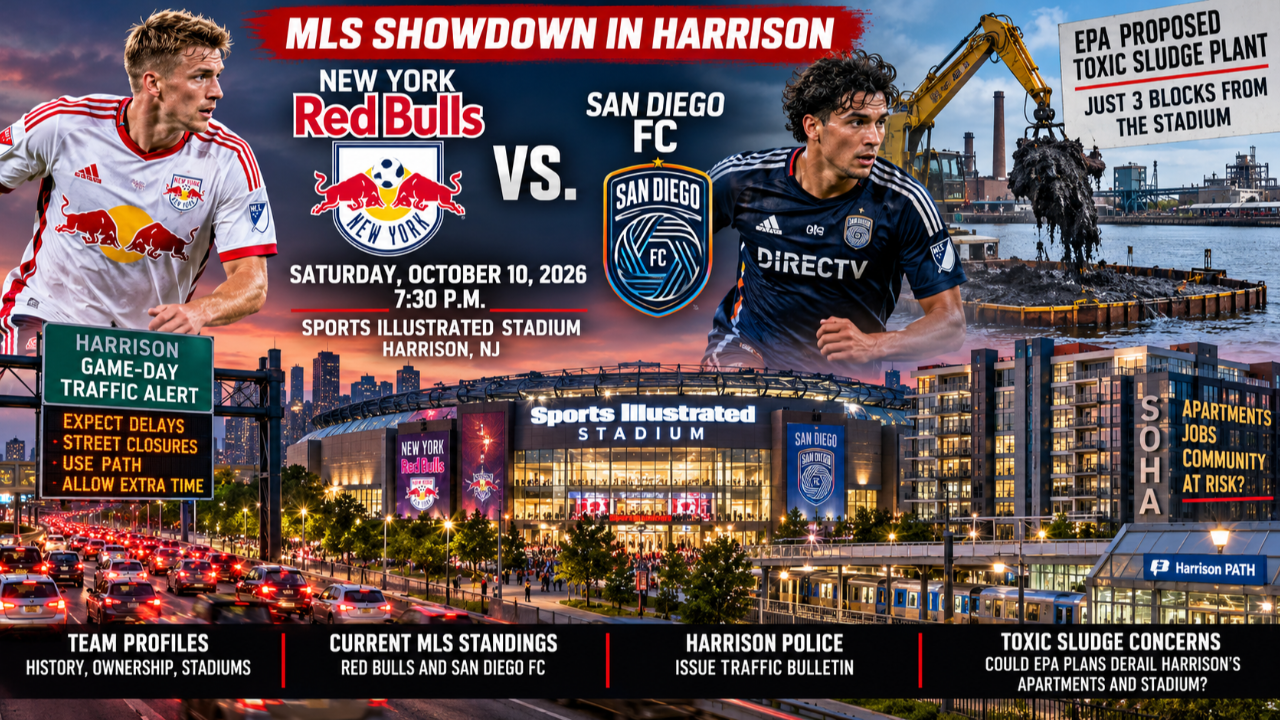
Saturday night's Major League Soccer matchup brings San Diego FC to Sports Illustrated Stadium, while renewed concerns about a proposed EPA sediment-processing facility near the stadium raise questions about Harrison's residential redevelopment and future.
The New York Red Bulls will face San Diego FC on Saturday, October 10, 2026, at 7:30 p.m. at Sports Illustrated Stadium, formerly Red Bull Arena, in Harrison, New Jersey.
The matchup brings together one of Major League Soccer's established franchises and one of its newest clubs. It also means another busy evening for Harrison residents, particularly those living in the town's rapidly developed South Harrison (SOHA) neighborhood surrounding the stadium and the Harrison PATH station.
The Harrison Police Department is expected to issue a traffic bulletin for the match, alerting residents and motorists to game-day traffic conditions.
As thousands of soccer fans travel to Harrison, the event also highlights a larger question facing the community: How will the proposed Environmental Protection Agency facility, intended to process contaminated sediment from the Passaic River, affect Harrison's transformation from an industrial center into a modern residential and entertainment destination?
The proposed facility would be located on former Public Service Electric & Gas (PSE&G) property along South Frank E. Rodgers Boulevard, between the Jackson Street Bridge and the Harrison PATH station, only a few blocks from Sports Illustrated Stadium.
San Diego FC: Major League Soccer's newest expansion success story.
San Diego FC represents a new generation of Major League Soccer franchises. MLS awarded the club an expansion franchise in May 2023, and it began competing in 2025 as the league's 30th team.
British-Egyptian businessman Sir Mohamed Mansour and the Sycuan Band of the Kumeyaay Nation, a Native American tribe with deep historical roots in Southern California, jointly own the organization.
The ownership arrangement is particularly significant because it established a groundbreaking role for Native American ownership in major professional soccer. Other investors include San Diego Padres baseball star Manny Machado, Spanish soccer player Juan Mata, actress Issa Rae, and singer Tems.
The club is also associated with the Right to Dream soccer development network, which operates youth academies and professional soccer programs internationally.
Snapdragon Stadium: San Diego's home field
San Diego FC plays at Snapdragon Stadium, located at 2101 Stadium Way in San Diego, California, within San Diego State University's Mission Valley development.
The stadium opened in August 2022 and also serves San Diego State University's football program and San Diego Wave FC of the National Women's Soccer League.
The stadium is commonly listed as having a maximum seating capacity of about 35,000 spectators, although San Diego FC's official stadium information lists 32,250 seats in its soccer configuration.
By comparison, Sports Illustrated Stadium in Harrison seats approximately 25,000 spectators. Using the 35,000-seat figure, Snapdragon Stadium can accommodate 10,000 more spectators, or approximately 40% more than Harrison's stadium.
San Diego made an immediate impression in its inaugural MLS season, reaching the 2025 Western Conference Final before losing 3-1 to the Vancouver Whitecaps. It was a remarkable postseason achievement for a first-year expansion team.
New York Red Bulls: A founding MLS franchise with deep New Jersey roots
The New York Red Bulls have been part of Major League Soccer since the league's inaugural season in 1996.
Originally known as the New York/New Jersey MetroStars, the franchise was established in 1994 in preparation for MLS competition. The Austrian energy-drink company Red Bull acquired the team in 2006 and renamed it the New York Red Bulls.
The Red Bulls have won the MLS Supporters' Shield three times, in 2013, 2015, and 2018. The award recognizes the club with the best regular-season record across Major League Soccer.
The team's home is Sports Illustrated Stadium at 600 Cape May Street in Harrison. The facility opened in March 2010, with the Red Bulls defeating Brazilian club Santos 3-1 in an exhibition match.
Originally called Red Bull Arena, the facility received its current name in December 2024 following a 13-year naming-rights and ticketing partnership with Sports Illustrated Tickets. EPA once used the Sports Illustrated Stadium (then known as Red Bull Arena) to compare how much toxic sludge they were removing from the Passaic River, saying it would fill the stadium. Who knew they were planning to put a Toxic Sludge Plant just blocks from the stadium? Harrison Mayor James Fife and Councilman James Doran knew, but they did not tell anyone until it slipped out at a Harrison Redevelopment meeting. Read more about it here.
The stadium features a partially covered seating bowl, a natural-grass playing surface, and an intimate design that places spectators close to the action. It is also home to Gotham FC of the National Women's Soccer League.
The facility has become one of Harrison's most recognizable landmarks and has hosted international soccer teams, major tournaments, and entertainment events, bringing visitors from across New Jersey, New York, and beyond.
Where the teams stand heading into Saturday's match
The Red Bulls and San Diego FC enter Saturday's contest with closely matched records, separated by just one point.
NEW YORK RED BULLS
33 pts
9 wins · 12 losses · 6 draws
Eastern Conference
SAN DIEGO FC
32 pts
8 wins · 11 losses · 8 draws
Western Conference
Both clubs have played 27 league matches, so Saturday's contest matters as they look to improve their positions in the closing stretch of the regular season.
The Red Bulls are coming off a difficult 3-0 home loss to St. Louis City SC but previously recorded consecutive 1-0 road victories over Columbus Crew and rival New York City FC.
San Diego has also experienced mixed results, including draws against Austin FC and Inter Miami CF, following a difficult stretch of losses.
A first-ever meeting, rather than an established rivalry
Saturday's match will be the first competitive meeting between the New York Red Bulls and San Diego FC, according to the Red Bulls' official pregame preview.
As a result, there are no previous head-to-head matches or memorable encounters between the two clubs to recount. Instead, Saturday offers a chance to write the first chapter of what could become an interesting interconference rivalry.
The Red Bulls' pregame statistics also point to young attacker Julian Hall as a key offensive contributor, with 13.19 expected goals entering the contest.
The official MLS standings rank the Red Bulls eighth in the Eastern Conference with 33 points. That puts New York in a playoff-qualifying position, though it's far from secure.
San Diego is competing in the Western Conference with 32 points. Its exact current conference position could not be independently verified from the available standings information.
Harrison Police issue traffic bulletin for Saturday's match
The Harrison Police Department has issued a traffic bulletin for Saturday evening's Red Bulls game, warning motorists and residents of changes to normal traffic patterns around Sports Illustrated Stadium.
The 7:30 p.m. kickoff means fans will arrive well before the match, increasing traffic on streets connecting Harrison to Newark, Kearny, Interstate 280, and the surrounding highway network.
Particular areas of concern include South Frank E. Rodgers Boulevard, Cape May Street, nearby residential streets, and the approaches to the Harrison PATH station.
For SOHA residents, stadium events can mean temporary street restrictions, congestion near residential parking garages, and delays entering or leaving apartment buildings.
Residents should consult the Harrison Police Department's game-day traffic bulletin for specific street closures, restrictions, and access arrangements. The precise closure schedule could not be independently confirmed.
Fans attending the game may want to use PATH service to Harrison Station, within walking distance of the stadium. Motorists should allow extra travel time and expect congestion before kickoff and after the final whistle.
Saturday's match is also being promoted as Noche Latina, a celebration of Latino culture and the Hispanic community.
Just three blocks away: Harrison's proposed EPA Toxic Sludge Plant
While Saturday's game offers another chance to showcase Harrison as a modern destination for professional sports and entertainment, an environmental controversy just blocks away threatens to overshadow the town's redevelopment accomplishments.
Approximately three blocks from Sports Illustrated Stadium, on the former PSE&G Gas Works property along South Frank E. Rodgers Boulevard between the Jackson Street Bridge and Harrison PATH station, the Environmental Protection Agency's Lower Passaic River cleanup plans have raised serious concerns about the handling of toxic sediment and debris.
The EPA's cleanup project involves sediment contaminated by decades of industrial pollution, including dioxins, polychlorinated biphenyls (PCBs), heavy metals, and other hazardous substances.
In September 2026, the EPA announced a proposed $125 million settlement with Environmental Resource Holdings LLC to advance the cleanup. The agreement includes construction of an upland sediment-processing facility and support facilities for river dredging and related work.
The distinction between the processing facility and its supporting operations is important. Project information identifies a separate principal upland processing facility near River Mile 0.3, while describing Harrison as a location for supporting activities involving materials, river debris, and construction operations. It will also be an open-air toxic sludge plant. The precise handling and quantities of contaminated dredged sediment at the Harrison property warrant clear public documentation. Microscopic particles of cancer-causing dioxin will be released from the sludge into the air just across the street from residential apartment buildings and three blocks from the Sports Illustrated Stadium.
For Harrison residents, the concern is not simply that the Passaic River needs environmental remediation. The question is whether contaminated material should be handled immediately alongside a community transformed into a densely populated residential and entertainment district. It is no longer an abandoned contaminated industrial area from 30 years ago. It has been transformed into a productive residential community.
Dioxin contamination raises questions about public health
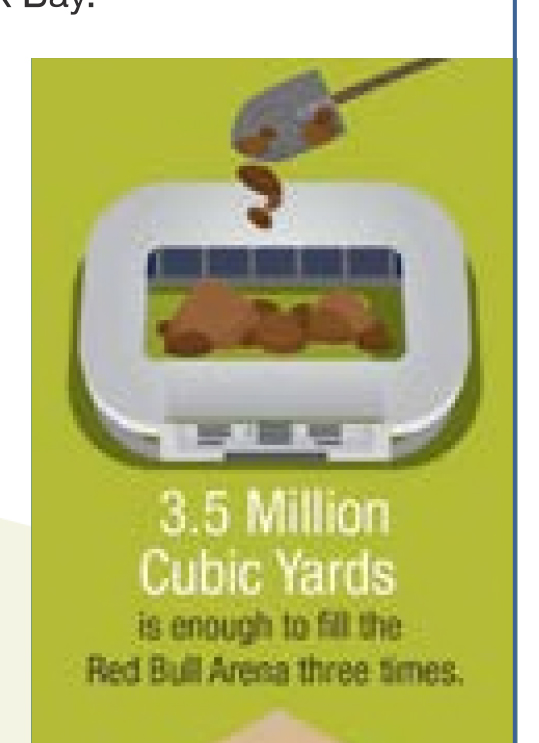
EPA Graphic from 2016: 3.5 Million Cubic Yards Is Enough to Fill the Red Bull Arena Three Times
Dioxins are among the most concerning contaminants associated with the historic Diamond Alkali chemical manufacturing operations in Newark.
The EPA has documented dioxin contamination in the Lower Passaic River, along with PCBs, pesticides, and metals. Some dioxins, particularly 2,3,7,8-TCDD, are highly toxic and associated with serious long-term health risks.
The prospect of disturbing contaminated sediment, handling debris, transferring material, and transporting waste through an increasingly populated area raises legitimate questions about potential exposure pathways.
Those concerns include airborne contaminated dust, odors, truck emissions, noise, possible accidental releases, and the movement of material through an area used daily by apartment residents, pedestrians, motorists, and PATH commuters.
EPA and project representatives describe environmental monitoring and other protective measures intended to prevent contamination from reaching surrounding communities. Harrison's question is whether those protections will be sufficient, since the plant will be across the street from residential apartment buildings. There is insufficient time to warn the community.
It has been suggested to EPA that it should not place the Toxic Sludge Plant in a residential community when alternative sites are available in South Kearny, which remains an industrial zone and would put miles between the plant and a residential community. However, the EPA is seeking cost savings rather than fulfilling its mission of protecting human health.
Could the sludge project derail Harrison's residential renaissance?
Harrison is no longer the industrial community it was during the twentieth century.
For decades, the town was known for its manufacturing plants, factories, railroads, and heavy industry. That landscape has changed dramatically, especially south of Interstate 280.
Today, the SOHA district contains modern apartment communities such as Steelworks, Vermella, Cobalt, Urby, One Harrison, and other residential developments offering amenities designed to attract professionals, families, and commuters seeking convenient access to New York City.
Residents have been drawn by the Harrison PATH station, restaurants, recreation, and proximity to Sports Illustrated Stadium.
The transformation has required enormous private investment and has also provided Harrison with a growing tax and payment-in-lieu-of-taxes (PILOT) revenue base.
The proposed environmental operations on the former PSE&G property could seriously conflict with that redevelopment strategy.
Apartment developers market Harrison as a convenient, modern, pedestrian-friendly community. A large-scale industrial operation involving contaminated river material could undermine that image, even if the EPA maintains that the operation can be conducted safely.
The economic risk extends beyond direct exposure to contaminants.
The perception that a neighborhood is located near a toxic-waste handling facility could affect prospective renters' decisions, apartment occupancy, future rental demand, property values, and developers' willingness to invest additional money in the community.
These are potential consequences, not demonstrated economic losses. Nevertheless, they deserve consideration before the town's residential transformation is paired with a long-term industrial remediation operation.
For Harrison, the stakes extend beyond the immediate neighborhood. Any significant weakening of its residential market could eventually affect municipal revenues and the financial assumptions underlying future redevelopment.
Sports Illustrated Stadium: Could a Toxic Sludge Operation Threaten Harrison's Sports Economy?
Sports Illustrated Stadium is one of Harrison's most valuable entertainment assets.
With seating for 25,000 spectators, the stadium attracts soccer supporters from throughout the metropolitan area and beyond. Beyond Red Bulls matches, it hosts Gotham FC, international soccer events, and other major gatherings.
Those events bring people to Harrison who might otherwise have little reason to visit.
Fans use the PATH station, walk along South Frank E. Rodgers Boulevard, park in local garages, and patronize businesses in and around the redevelopment district.
But what happens if the surrounding neighborhood becomes associated with the handling of dioxin-contaminated sludge and industrial debris?
Would soccer fans with children feel as comfortable visiting Harrison if they believed contaminated material was being processed or transported nearby?
Could the perception of environmental danger make the stadium less attractive for future international soccer matches, concerts, or other large events?
Would event organizers, corporate sponsors, and stadium operators seek additional environmental assurances before committing to major events?
These questions do not establish that the EPA project will cause the Red Bulls to leave Harrison or that stadium events will be canceled. No verified evidence supports either outcome.
They do, however, illustrate the potential reputational and economic risks that accompany the proposed industrial activity near an important regional sports venue.
For a town that has spent years repositioning itself as a residential and entertainment destination, public confidence is an economic asset worth protecting.
A Cleaner Passaic River Should Not Come At The Expense Of Harrison's Future
The EPA maintains that removing contaminated sediment from the Passaic River is necessary to address decades of industrial pollution and improve the river's environmental condition.
The benefits of cleaning the river are important. But those benefits must be weighed against the potential consequences of bringing industrial cleanup operations into communities that have changed significantly since the river was first contaminated.
Harrison's former industrial waterfront is now surrounded by apartment buildings, transportation facilities, pedestrian activity, and one of the region's premier soccer stadiums.
The former PSE&G property was also previously envisioned as an opportunity for additional public amenities, including recreational green space and community facilities.
Instead, Harrison may have to support a lengthy environmental remediation project that could bring truck traffic, industrial equipment, debris handling, and other activities into the heart of its redevelopment district.
Flooding A Reality in SOHA Harrison PATH
Flooding is also a concern. Harrison has experienced significant stormwater problems near the PATH station and South Frank E. Rodgers Boulevard, raising additional concerns about protecting contaminated material during severe weather events.
Residents deserve more than general assurances that environmental safeguards will be implemented. They deserve specific information about the types of material handled at the Harrison site, how much contaminated material could be present, how it would be contained, and what emergency measures would apply during storms, equipment failures, or accidental releases.
Saturday's Game Illustrates What Harrison Has Become And What It Stands To Lose
When the Red Bulls take the field against San Diego FC on Saturday evening, the match will demonstrate how dramatically Harrison has changed.
A town once identified with smokestacks, factories, and heavy industry is now home to a modern professional soccer stadium, thousands of apartments, and a transportation hub serving the New York metropolitan area.
San Diego FC represents the continuing growth of professional soccer in America. Sports Illustrated Stadium represents Harrison's successful participation in that growth.
But the EPA project raises an important question about the town's future.
Can Harrison keep attracting residents, investment, visitors, and international sporting events while accommodating industrial operations tied to some of the most heavily contaminated sediment in the Passaic River?
For now, Saturday's matchup offers soccer fans an evening of Major League Soccer competition while reminding Harrison residents that the town's future involves more than what happens on the field.
It also involves protecting the community that has grown around it.
Your Harrison Is Your Community — Join the Conversation
Local news is better when the community is part of it. After reading this article, tell your neighbors what you think, share information, ask questions, or start a discussion on the Community Discussion Board.
Not a member yet? Joining Your Harrison is free. Join a growing community of residents, former residents, local business owners, and others who care about what is happening in Harrison and West Hudson.
Join Your Harrison FREE today, then make your voice part of the conversation.
Submit An Article