Fife and Doran Mislead Harrison Residents on EPA Toxic Sludge Plant
Oct 09, 2026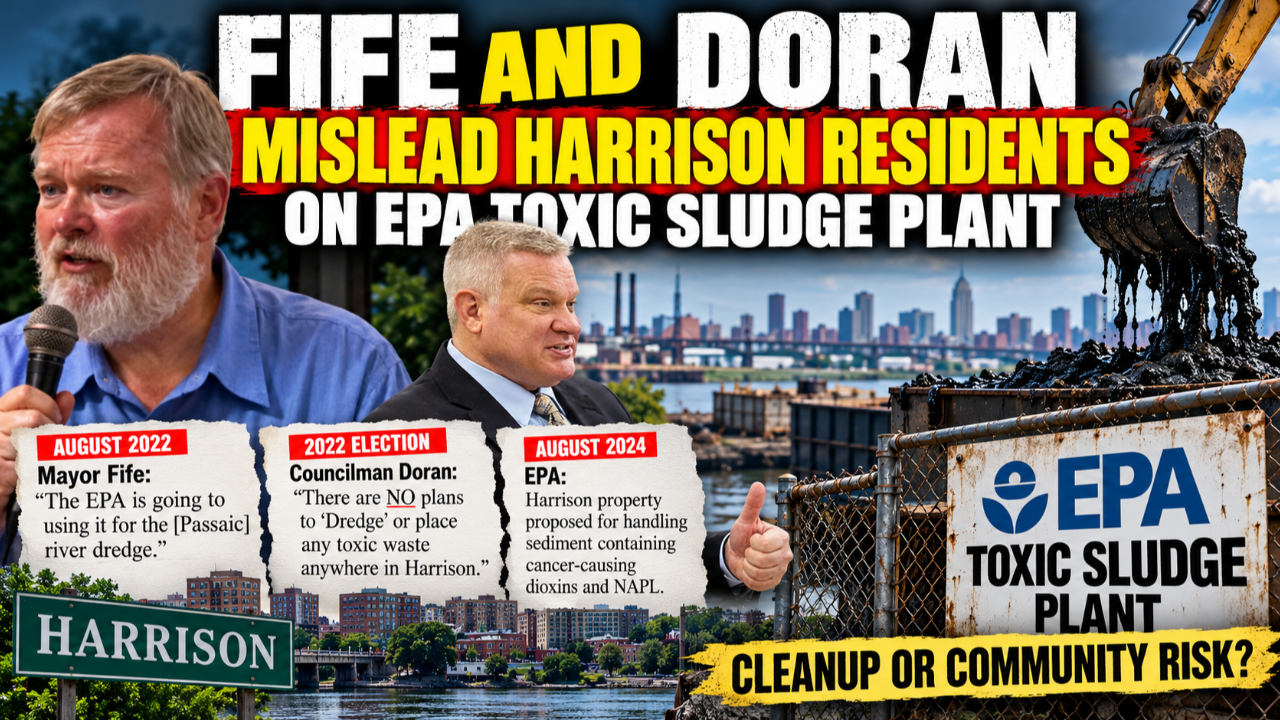
Mayor Fife's latest letter to residents downplays the proposed EPA Toxic Sludge Plant in Harrison while attacking critics who have questioned the project's location and potential impact on public health.
The controversy dates back to August 2022 (4 years ago), when Fife publicly acknowledged EPA's plans for the PSE&G property between the Harrison PATH and the Jackson Street Bridge, across from modern, amenity-filled apartment buildings, only to later deny making that statement.
During a contested race for Mayor in 2022, Councilman James Doran followed up with campaign communications assuring residents that no toxic waste would be placed anywhere in Harrison. Four years later, the proposed use of the Harrison property remains part of EPA's cleanup plans, raising renewed questions about what Harrison's elected officials knew, what they told the public, and why they continue to support the project despite substantial community opposition.
Mayor James Fife and the Harrison Team have issued a statement accusing critics of the proposed Environmental Protection Agency (EPA) Toxic Sludge Plant at the PSE&G property in Harrison of spreading fear and misinformation.
Their statement begins:
“Fear is not evidence. Facebook posts are not engineering studies. Political attacks are not environmental science.”
The statement defends the proposed Lower Passaic River cleanup, emphasizes that the principal sediment-processing facility is planned for Newark, and rejects suggestions that Harrison residents will be exposed to cancer-causing dioxin particles as a result of EPA's project.
However, the Mayor's latest statement fails to address the history of this controversy, particularly statements Fife and Councilman James Doran made during the 2022 mayoral election.
That history matters because it shows the Mayor knew EPA intended to use the former PSE&G property for its Passaic River dredging project long before the current controversy.
The public deserves to know why Fife and Doran assured residents in 2022 that the project wasn't coming to Harrison when the Mayor had already publicly acknowledged EPA's anticipated use of the property. Fife & Doran knew it was coming but did not alert the public.
What Mayor Fife Said in August 2022
At the August 29, 2022, Harrison Redevelopment Agency meeting, Mayor Fife discussed the former PSE&G property and acknowledged that EPA intended to use it for the Passaic River dredging project.
As documented in a recorded meeting, Fife stated:
Fife also stated that the operation could last ten years. It's actually going to last 10 or 20 or 30 years, depending on who you ask at EPA.
That statement's significance cannot be overstated.
The Mayor was acknowledging, months before the November 2022 mayoral election, that EPA intended to use the former PSE&G property for its river dredging operation.
The property was not an insignificant parcel of vacant industrial land. It was a substantial redevelopment site where the Town had previously contemplated public improvements, including recreational space, a Green Space, a Park, a multi-level Community Center, and a Turnaround and Drop-off zone for the Harrison PATH station.
Instead, according to the Mayor's own words, EPA's anticipated use of the property was preventing those plans from moving forward.
Fife Denies His Own Statement as the 2022 Election Approaches
The controversy intensified the following month in September 2022 during a Harrison Mayor and Council meeting.
When confronted about his August 29 statement, Mayor Fife denied making the statement about EPA's anticipated use of the former PSE&G property.
However, his earlier remarks appeared in a Zoom recording of the Harrison Redevelopment Agency meeting. Link here.
That recording is especially significant because Harrison Redevelopment Agency and Mayor and Council meetings were not routinely recorded for public access.
In this case, the recording preserved the Mayor's exact words and let residents compare what he said in August with his later denial.
The contradiction was not simply a disagreement over environmental policy. It concerned whether the Mayor had accurately informed residents about a major proposed industrial operation in a community undergoing extensive residential redevelopment.
The Your Harrison article previously examined the events, "Concealment, The Truth & Lies About EPA's Toxic Sludge Plant in Harrison NJ."
Councilman Doran Assures Residents No Toxic Waste Is Coming to Harrison
With the mayoral election approaching, Councilman James Doran distributed election-related communications rejecting allegations that Harrison is planning dredging or toxic-waste handling.
One statement from Doran declared:
“I can say with 100% surety that there are NO plans to ‘Dredge’ or place any toxic waste anywhere in Harrison.”
The correspondence also accused then-Councilman Anselmo Millan and local attorney John Pinho of inventing the issue to frighten residents during the election.
Doran's statement was categorical.
Although the first portion could be interpreted as denying that dredging would occur directly at the Harrison property, the second portion went considerably further, assuring residents that no toxic waste would be placed anywhere in Harrison.
That broader assurance is difficult to reconcile with EPA's descriptions of the proposed Harrison support facility and Mayor Fife's statement.
Councilman Doran also served as a Commissioner of the Passaic Valley Sewerage Commission (PVSC), an agency whose Newark property was later identified as the proposed location for the principal sludge-processing facility.
His public position and institutional connections make his 2022 statements particularly important.
The Mayor and Councilman also distributed election communications accusing Millan and Pinho of misleading the public.
Yet the Mayor's recorded August 2022 statement established that he already knew EPA's anticipated use of the Harrison property.
What Fife and Doran presented as political misinformation in 2022 has become a central issue in EPA's publicly discussed cleanup plans in 2026.
The question is no longer whether the Mayor knew about EPA's interest in the Harrison property. His recorded statement establishes that he did.
The question is why he subsequently denied making that statement and why Doran assured residents that no toxic waste would be placed anywhere in Harrison.
EPA's 2024 Presentations Confirm Harrison's Role
The issue did not disappear following the 2022 election.
EPA's August 2024 presentation identified the principal sludge-processing facility at the Passaic Valley Sewerage Commission property in Newark, along with support facilities in Harrison, NJ, which include a Toxic Sludge Plant.
EPA Project Manager Alice Yeh explained that the Harrison property was proposed for handling sediment affected by oily, tar-like contamination associated with historical manufactured-gas operations.
The contaminants discussed included dioxins and non-aqueous phase liquids (NAPL), hazardous substances associated with serious long-term health effects, including various forms of cancer. NAPL refers to oily or tar-like substances that do not readily dissolve in water and may contain hazardous chemical compounds.
These materials are among the reasons the Lower Passaic River has undergone extensive environmental investigation and cleanup planning.
The EPA presentations confirmed that Harrison was not merely a community located near a cleanup operation. The Town's former PSE&G property was itself part of the proposed cleanup infrastructure.
The Mayor's latest letter correctly identifies the PVSC property in Newark as the proposed principal sediment-processing site.
However, that fact does not eliminate the proposed support facility in Harrison or resolve concerns about handling contaminated material near residential buildings, businesses, and the PATH transportation hub. Let us not forget the Northeast Rail Corridor.
Calling Newark the principal processing location does not answer the separate question of what activities EPA intends to conduct in Harrison. In many ways, the Harrison Toxic Sludge Plant is worse than the Newark Toxic Sludge Plant. Harrison is an open-air plant, and Newark is enclosed from collection to processing.
Mayor Fife Expresses Support at the August 2024 EPA Meeting
The public disagreement became particularly visible during EPA's August 27, 2024, community meeting at Harrison High School. Almost two years to the date that Mayor Fife inadvertently revealed a secret Doran and he were hiding. The truth was that a Toxic Sludge Plant was planned for the PSE&G property in Harrison.
Residents, municipal officials, and representatives of neighboring communities attended the meeting to hear EPA officials discuss the proposed cleanup and answer questions about contaminated sediment, dewatering, transportation, flooding, and public-health safeguards.
Numerous residents opposed locating a facility that handles contaminated river sediment in a community that has undergone extensive residential redevelopment. One resident renter tried to pin down when the Toxic Sludge Plant would be operational. When he didn't get a specific answer, he asked for an estimate so he wouldn't renew his lease past that date.
Attendees' objections focused on the proximity of apartment buildings, the potential movement of contaminated material, truck traffic, environmental monitoring, flooding, and the possibility of airborne exposure during handling operations.
The Observer Newspaper Coverage
Kevin Canessa Jr., editor of The Observer, documented the meeting and reported on residents' concerns. The video is available through this link.
The newspaper's September 4, 2024, account recorded Mayor Fife's response when asked about the Town's position.
“I’m not in favor of stopping it,” Fife said.
In other words, Harrison Mayor James Fife supported a Toxic Sludge Plant in Harrison, NJ.
The Mayor argued that the river should be cleaned, citing Harrison's industrial history and earlier environmental remediation projects.
His remarks made it clear he supported a Toxic Sludge Plant in Harrison, even as residents voiced objections to the proposed location.
For residents who had been assured during the 2022 election that toxic waste would not be placed in Harrison, the Mayor's position was particularly troubling.
Residents opposing the Harrison facility are not necessarily opposing the Passaic River cleanup. Many are questioning why contaminated sediment should be handled at a property now surrounded by residential development when alternative industrial locations may be available.
The Mayor's response did little to resolve that concern.
The October 6 Mayor and Council Meeting Is Canceled
The latest controversy also coincides with the cancellation of a regularly scheduled public meeting.
The Town of Harrison's official calendar identifies the Tuesday, October 6, 2026, Mayor and Council meeting as canceled.
The cancellation is particularly significant because the meeting would have occurred during the federal public-comment period for the proposed EPA settlement concerning contamination of the Lower Passaic River.
Harrison's regular Mayor and Council meetings provide residents with an opportunity to address their elected representatives during the public-comment portion of the meeting.
Canceling the October 6 meeting eliminated a scheduled opportunity for residents to express their concerns directly to Mayor Fife and the Council before the federal comment deadline.
The EPA and the United States Department of Justice have set Thursday, October 15, 2026, as the deadline to submit comments on the proposed Environmental Resource Holdings consent decree. EPA formed Environmental Resource Holdings as the entity the identified Polluters used for litigation purposes.
Residents can still submit comments directly to the federal government up to October 15, 2026. Nevertheless, a public discussion at the scheduled Mayor and Council meeting would have given Harrison residents an opportunity to hear where their elected representatives stand on the proposed facility.
The timing of the cancellation is troubling, especially when the Mayor and Council publicly criticize residents who have raised concerns about the project.
If the administration believes the facts support its position, residents should have an opportunity to question it at a public meeting.
The September 15 Council Meeting: Doran Again Accuses Long-Time Opponent of Toxic Sludge Plant of Lying
The October cancellation followed a contentious exchange during the public-comment portion of the September 15, 2026, Mayor and Council meeting.
Local attorney John Pinho addressed the Council on the recently proposed federal consent decree to settle litigation over contamination of the Lower Passaic River.
Pinho urged the Mayor and Council to oppose the proposed Toxic Sludge Plant at the former PSE&G property in Harrison.
During that exchange, Councilman James Doran interrupted to accuse Pinho of lying about the proposed facility and suggested that Pinho had a mental condition.
Pinho responded that he was not the person with a mental condition.
The exchange reflected how Doran deals with anyone who opposes his point of view. Imagine Doran was a former Superintendent of Harrison Schools and then a Director of Personnel etc. for the Harrison Public Schools. How did he interact with staff?
It also recalled the controversy during the 2022 mayoral campaign, when Doran attacked Pinho and then-Councilman Anselmo Millan for raising concerns about the proposed use of the Harrison property.
During an earlier September 2022 Mayor and Council meeting, Doran also directed a verbal attack at Pinho, calling him a “blowhard,” and then moved a Motion to Dismiss (Pinho), which the Town Clerk corrected to a Motion to Adjourn. Link to video here.
Rather than addressing the substance of residents' concerns about the facility, these exchanges have increasingly focused on attacking the credibility and motives of individuals who oppose the Harrison location.
That approach does not resolve the underlying issue.
The public still deserves a clear explanation of why the Town's elected officials are willing to accept an EPA facility involving contaminated river sediment at a property located near residential developments and one of the region's busiest transportation hubs.
The Issue Is Not Whether the Passaic River Is Polluted
Mayor Fife's latest letter emphasizes the history of industrial contamination in the Lower Passaic River.
That history is not disputed.
EPA has documented dioxins, polychlorinated biphenyls (PCBs), pesticides, metals, and other hazardous substances in the river.
The federal cleanup program is intended to address those conditions through dredging, off-site disposal, and capping.
However, acknowledging that the river is contaminated does not automatically justify every location selected for handling contaminated sediment.
There is an important distinction between supporting the cleanup of the Passaic River and supporting the placement of a facility handling hazardous river sediment in a residential community.
Harrison is no longer the heavily industrial municipality it was decades ago.
The Town has undergone substantial redevelopment, with new apartment buildings, businesses, pedestrian activity, and public transportation facilities occupying areas that were once dominated by factories and industrial operations.
Residential developments such as Steelworks, Vermella, Cobalt, and other apartment communities are part of this transformation. A sports and concert facility, the Sports Illustrated Stadium.
The Harrison PATH Station serves residents, commuters, and visitors traveling between New Jersey and New York City.
The proposed EPA facility must therefore be evaluated in the context of Harrison as it exists today, not simply as it existed during its industrial past.
EPA maintains that the cleanup can be performed using engineering controls, environmental monitoring, and other protective measures.
Nevertheless, residents have questioned whether those measures adequately address the risks associated with handling contaminated material near apartment buildings and public transportation facilities.
They have also raised concerns about truck traffic, airborne contamination, flooding, and the possible release of hazardous particles during the handling and processing of contaminated sediment.
Dioxins are known to present serious health hazards under certain exposure conditions. Whether the proposed operations would increase exposure among nearby residents and commuters depends on the activities performed, the effectiveness of protective measures, and the actual exposure pathways.
Those questions deserve careful scientific evaluation rather than dismissal as political misinformation.
The potential benefits of cleaning the Passaic River do not eliminate the responsibility to examine whether the proposed Harrison location is appropriate. There are other location including South Kearny which is industrial and not residential community across the street.
Harrison's Flooding History Adds to Residents' Concerns
Another concern involves the former PSE&G property's proximity to the Passaic River and the history of flooding in the surrounding redevelopment area.
Residents have witnessed flooding near the Harrison PATH Station and neighboring streets during rain storms.
The possibility of floodwaters affecting a facility involved in handling contaminated sediment raises additional questions about containment, emergency procedures, and environmental safeguards.
EPA may have engineering plans intended to address flooding and stormwater management. EPA at meetings has talked in generalities and stated they currently don’t have a design of the Toxic Sludge Plant. It’s an Open Air Toxic Sludge plant. Amazing considering the air borne dioxin known that it will occur.
For residents living near the proposed facility, the consequences of an equipment failure, containment problem, or unexpected flooding event are legitimate subjects for public discussion.
The Mayor's latest letter does not resolve those concerns merely by pointing to the environmental benefits of cleaning the river. You can clean the river and put zero Toxic Sludge on land in Harrison. No resident should have to risk exposure by EPA, an entity founded to protect public health. A Toxic Sludge Plant in a residential community is just ludicrous. There are alternative industrial locations that the toxic sludge can go to be processed. The USA is not a Third World Country.
EPA Has Not Identified a Comparable Facility in a Residential Community
One question raised by opponents of the proposed Harrison facility remains especially important.
Where else in the United States has EPA established a comparable contaminated-sediment handling facility in a densely developed residential community?
Critics have repeatedly sought examples of similar facilities operating near apartment buildings, businesses, and major public transportation infrastructure.
According to those critics, EPA has not provided a specific comparable example that satisfactorily answers the question.
That does not establish that no comparable facility exists. It does, however, highlight the need for EPA to provide the public with information about similar projects, their locations, operational histories, and environmental performance.
Harrison residents should not have to accept general assurances when their concerns involve the potential handling of dioxin-contaminated sediment close to their homes.
If the proposed facility is safe and appropriate for this location, EPA should be able to explain why and provide evidence supporting that conclusion. They have not done that at any of their meetings.
Without changing the current plans, Harrison could become the example cited in future discussions about locating contaminated-sediment facilities near residential neighborhoods.
Residents should not be expected to accept that distinction without serious public examination.
Four Years of Contradictory Statements
The controversy surrounding the proposed Harrison Toxic Sludge Plant can be traced through a series of events extending from 2022 to the present.
In August 2022, Mayor Fife publicly acknowledged that EPA intended to use the former PSE&G property for the Passaic River dredging project. A rare recording of a town meeting is linked here.
The following month, as the mayoral election approached, Fife denied making that statement despite the recording. Click here for recording video.
Councilman Doran subsequently distributed campaign communications assuring residents that no dredging or toxic-waste placement was planned anywhere in Harrison.
Those communications also accused then-Councilman Anselmo Millan and local attorney John Pinho of misleading residents.
In August 2024, EPA held a public meeting at Harrison High School where residents expressed substantial opposition to locating the proposed facility in their community. Click here for video.
At that meeting, Mayor Fife said he did not favor stopping the project. In other words, he was in favor of a Toxic Sludge Plant in Harrison, NJ.
In September 2026, Doran again accused Pinho of lying when Pinho urged the Mayor and Council to oppose the proposed Harrison facility.
Now, in October 2026, the Mayor and Council have issued another statement criticizing opponents of the project while emphasizing that the principal sediment-processing facility will be located in Newark.
What remains unresolved is the contradiction between the assurances made to residents during the 2022 election and EPA's subsequent public descriptions of the proposed use of the Harrison property.
Fife and Doran have had four years to explain those contradictions.
Instead, their latest statement continues to portray opposition to the project as the product of fear, misinformation, and political attacks.
The documented history tells a more complicated story.
The November 3 Election Gives Residents an Opportunity to Be Heard
The timing of the latest controversy is significant because Harrison voters will soon participate in the November 3, 2026, General Election.
Vote-by-mail ballots have already begun going out to voters.
In-person early voting begins on Saturday, October 24, 2026, and continues through Sunday, November 1, 2026. Election Day is Tuesday, November 3, 2026.
In-Person Early Voting
The election gives residents a chance to evaluate the positions of their elected officials, including how they handled the proposed EPA facility.
Residents dissatisfied with Mayor Fife's and Councilman Doran's positions can consider the candidates on the ballot and any eligible write-in candidates.
The issue is not simply whether Harrison should support cleaning the Passaic River.
It is whether the Town's elected representatives have adequately protected the interests of residents, commuters, and businesses while EPA advances a project involving hazardous river sediment.
Residents should also consider the statements made during the 2022 mayoral election and compare those assurances with what EPA has subsequently disclosed about the Harrison property.
Residents can review the public record.
October 15 Is the Deadline for Federal Comments
Before the November election, residents have another important opportunity to express their concerns.
The federal public-comment period on the proposed Environmental Resource Holdings consent decree closes Thursday, October 15, 2026.
The proposed settlement addresses responsibility for addressing contamination in the Lower Passaic River and implementing the federal cleanup program.
Residents who oppose using the former PSE&G property in Harrison for contaminated-sediment handling should let EPA and the Department of Justice know their concerns before the deadline.
The cancellation of the October 6 Mayor and Council meeting should not prevent residents from participating directly in the federal review process.
Harrison Deserves Better Than Political Attacks and Repeated Denials
Mayor Fife and Councilman Doran cannot erase this controversy's history by issuing another letter accusing critics of spreading misinformation.
The Mayor's August 29, 2022, statement was recorded.
His subsequent denial is part of the controversy.
Doran's campaign communications assuring residents that no toxic waste would be placed anywhere in Harrison are also part of the record.
EPA's 2024 presentations identified Harrison as a proposed support-facility location.
Mayor Fife also publicly stated at the Harrison High School meeting that he did not favor stopping the cleanup project. In other words, he is in favor of a Toxic Sludge Plant in Harrison NJ.
These are not merely Facebook rumors or political talking points. They are statements and events that residents can examine and evaluate.
The central concern remains the same as it was four years ago.
Why should Harrison, a municipality that has transformed from a contaminated, abandoned industrial center into a growing residential community, be expected to accommodate a facility that handles hazardous river sediment near homes, businesses, and the PATH Station?
Why would EPA’s Project Manager even consider it? Watch this video: John Pinho asks a question at an EPA meeting, and the EPA Project Manager answers, basically saying EPA will use the Harrison property if allowed. She knows it should not go into a residential community. Click here for the video.
The potential health consequences of exposure to contaminants such as dioxins are too serious to dismiss.
Residents have the right to demand that their elected officials oppose unnecessary environmental risks and advocate for alternative locations that would reduce exposure potential.
Mayor Fife and Councilman Doran have chosen to defend a Toxic Sludge Plant in Harrison rather than join residents seeking to prevent the proposed Harrison facility.
PSE&G Cleanup Shows EPA Selling Out to Polluters
Their political opponents and critics believe that EPA is trading public health for cost savings for polluters. That point is important; the EPA forced PSE&G to clean up its property at a cost of $360 to $410 million. EPA is accepting $270 million from Polluters. EPA’s settlement amount is totally inadequate for the Passaic River cleanup and a recipe for disaster. Why? Because toxic dioxin is currently encapsulated in the Sludge and, if left undisturbed, poses no danger to human life unless you eat crabs and fish from the Passaic River.
Nobody in Harrison eats the Passaic River fish and crabs. People do breathe in the air. EPA needs to try its case or insist on a much larger settlement to adequately fund the river cleanup. Otherwise, the sludge will keep doing its job at the bottom of the river until a better method for cleaning up the Passaic River is available.
An Alternate Way To Clean The Passaic River
Paul Lerin's video describes one alternative method. Click here to view the video..
Ultimately, Harrison residents will decide whether they agree.
Harrison is no longer the industrial town it once was. It is a residential community whose residents, commuters, and visitors deserve protection from avoidable environmental hazards.
The public should not have to wait until a contaminated-sediment facility operates across the street from apartment buildings to discover whether government officials' assurances were justified.
Residents must make their voices heard now. Please join the Community Effort to stop this ill-conceived Toxic Sludge Plant.
Your Harrison Is Your Community — Join the Conversation
Local news is better when the community is part of it. After reading this article, tell your neighbors what you think, share information, ask questions, or start a discussion on the Community Discussion Board.
Not a member yet? Joining Your Harrison is free. Become part of a growing community of residents, former residents, local business owners, and others who care about what is happening in Harrison and West Hudson.
Join Your Harrison FREE today, then make your voice part of the conversation.
Submit An Article