Harrison Parking Policies Raise Questions Over Garage Revenue
Aug 24, 2026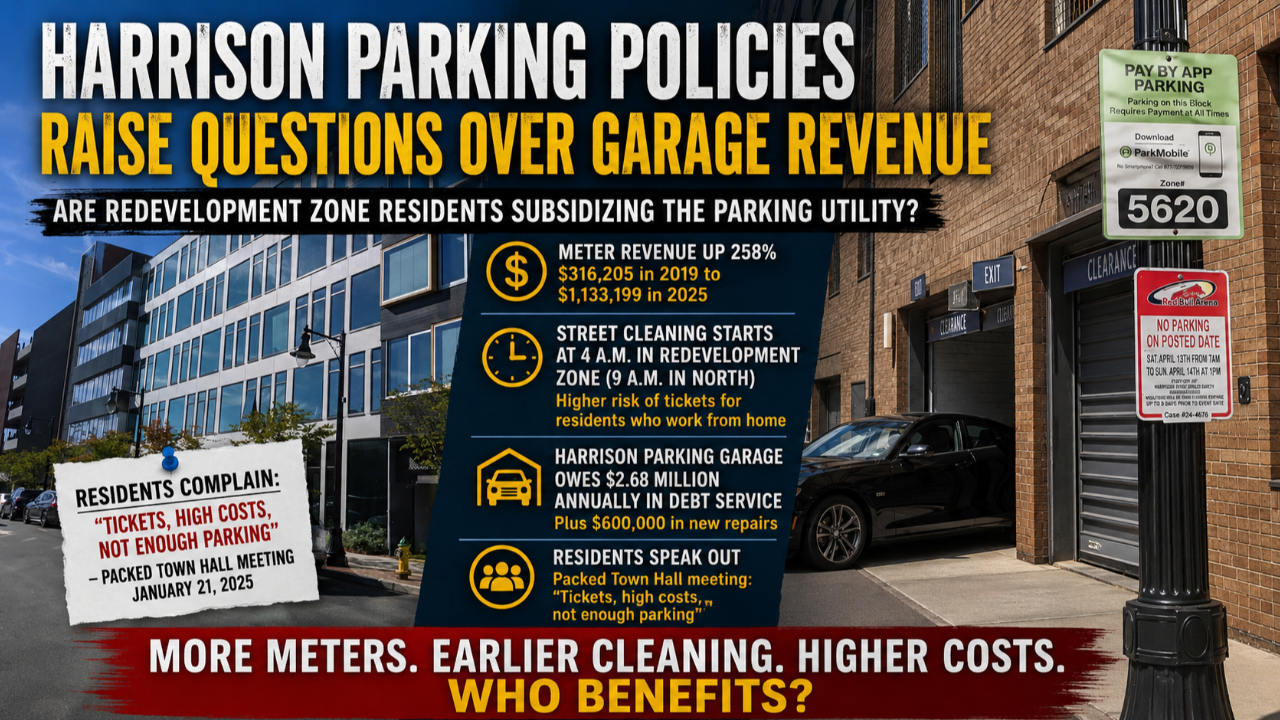
Revenue from the Town-owned Harrison Parking Center next to the Harrison PATH station remains below its former high, while revenue collected from Harrison's parking meters has more than tripled since 2019.
But where those parking meters are concentrated and how parking rules differ between northern and southern Harrison raises a larger question for residents of the densely developed neighborhood surrounding the PATH station:
Are residents of Harrison's Redevelopment Zone increasingly being called upon to help support a Parking Utility burdened with millions of dollars in garage debt?
The question takes on additional significance because residents in the Redevelopment Zone face two parking conditions that are substantially different from much of northern Harrison: widespread metered parking and street-cleaning restrictions beginning as early as 4 a.m.
Residents who fail to move their vehicles for street cleaning risk parking tickets. Those who do not want to get up before 4 a.m. to move their vehicles must find somewhere else to park and one alternative Town officials themselves have suggested to residents is the Harrison Parking Center.
Meanwhile, Harrison's own financial statements show parking-meter revenue increasing from approximately $316,000 in 2019 to more than $1.13 million in 2025, while the garage continues carrying millions of dollars in annual debt service.
Two Parts Of Harrison, Two Very Different Parking Environments
Understanding the issue requires understanding Harrison's geography. South of Interstate 280 is Harrison's Redevelopment Zone, including the neighborhood surrounding the Harrison PATH station and Sports Illustrated Stadium.
The former industrial district has been transformed by residential and commercial development, bringing thousands of new residents into apartment developments and creating a densely populated transit-oriented neighborhood.
It is also where Harrison has concentrated much of its metered street parking. Parking meters and ParkMobile payment requirements cover most streets within the Redevelopment Zone. South Frank E. Rodgers Boulevard is a notable exception because parking is generally not permitted along the roadway as it’s a main traffic artery.
The situation is substantially different in northern Harrison. Metered parking there is concentrated primarily along Harrison Avenue; Frank E. Rodgers Boulevard north of Bergen Street, including North Frank E. Rodgers Boulevard; a short section of North Third Street near Harrison Town Hall; and a municipal metered parking area underneath Interstate 280 between Harrison Avenue and Cleveland Avenue. Residents outside the Harrison Redevelopment Zone have free side street parking. Residents at several Harrison Mayor & Council meetings have requested a special zone for Harrison’s Redevelopment Zone residents to park free during the day, but the Mayor & Council rejected their proposal.
The geographic concentration of meters therefore matters when examining Harrison's rapidly increasing meter revenue.
Harrison Does Not Publish Meter Revenue By Neighborhood
The geographic concentration of meters therefore matters when examining Harrison's rapidly increasing meter revenue.
There is one important limitation. Harrison's publicly available budgets and financial statements report parking-meter revenue on a Town-wide basis. They do not identify how much was collected on an individual street or distinguish between collections in the Redevelopment Zone and northern Harrison.
One currently cannot state from published municipal financial records exactly how much of Harrison's $1.13 million in 2025 meter revenue came from the Redevelopment Zone.
The Town of Harrison uses a combination of feeding the meter with Quarters and/or use of the ParkMobile application. ParkMobile transaction records broken down by parking zone or location are not available online as a public record.
What can be established is that metered parking is far more extensively distributed throughout the Redevelopment Zone than in northern Harrison.
Parking Meter Revenue Has Exploded
The financial numbers are striking. In 2019, Harrison collected only $316,204.93 in parking-meter revenue. In 2025, meter collections reached $1,133,199.08
Harrison's 2025 Annual Financial Statement confirms that the Town budgeted only $810,000 in meter revenue but actually collected $1.133 million, approximately $323,199 more than anticipated.
That represents an increase of approximately 258 percent compared with 2019.
At the same time, Harrison's garage has traveled in the opposite direction from its pre-2020 high.
Garage Revenue Still Has Not Returned To Its Former High
In 2019, the Harrison Parking Center generated approximately $5,818,053
By 2021, garage revenue had fallen to approximately:$1,513,791
Revenue has since recovered but not fully.
The garage generated approximately $2.77 million in 2022, $2.93 million in 2023, $3.19 million in 2024, and $4.43 million in 2025.
But even after that recovery, 2025 garage revenue remained approximately $1.38 million below its 2019 level.
That is where Harrison's rapidly increasing parking-meter revenue becomes especially significant. Between 2019 and 2025, annual meter revenue increased by approximately $817,000. That increase alone equals about 59 percent of the $1.38 million difference between 2019 and 2025 garage revenue.
Harrison does not formally label that money a "garage subsidy." Meter money becomes revenue of the broader Parking Utility, which has expenses and revenue sources beyond the garage.
Nevertheless, financially, increasing meter revenue is helping the Parking Utility compensate for garage revenue that has not returned to its former level.
A 4 A.M. Difference For Southern Harrison Residents
Another significant difference between parking in the Redevelopment Zone and northern Harrison is street-cleaning hours.
YourHarrison previously documented that street cleaning in northern Harrison begins at approximately 9 a.m., while portions of southern Harrison surrounding developments such as Urby, Vermella, Steelworks and Cobalt have street-cleaning restrictions beginning at 4 a.m.
That difference has practical consequences for residents. A resident in northern Harrison can ordinarily wake at a conventional morning hour and move a vehicle before a 9 a.m. restriction.
A resident subject to a 4 a.m. restriction has a much different choice. The vehicle must be moved before the restriction begins, parked somewhere unaffected by the restriction, placed in private parking, or potentially parked in a garage. Otherwise, the motorist risks receiving a parking ticket.
For residents who work from home, work irregular hours, have young children or simply do not want to wake in the middle of the night to relocate a vehicle, the distinction can have a substantial effect on daily life.
Residents Took Their Parking Complaints To Town Hall
Those concerns are not hypothetical. At the January 21, 2025 Mayor and Council meeting, Harrison resident Alex Roman and other residents from the neighborhood around 330 Cifelli Drive, across from the PATH station, publicly complained about parking conditions.
Residents complained about frequent parking tickets and the financial burden of continuously paying meters. When members of the Mayor & Council suggested that residents use the Harrison Parking Garage, residents pushed back.
They told officials that the garage's monthly rate was higher than neighborhood parking alternatives and raised concerns about availability during stadium events and overnight vehicle security. One resident explained that he preferred street parking near his home so he could check his vehicle periodically.
The exchange is particularly relevant today because it shows a clear connection between Harrison's street-parking policies and the municipal garage. Residents complained about the difficulty and expense of street parking. Town officials suggested the Harrison Parking Garage as an alternative.
Street Cleaning Creates Another Incentive To Use Garage
That connection becomes more significant when you consider the 4 a.m. street-cleaning schedule.
The 4 a.m. Street Cleaning issue isn’t new; residents raised it as early as November 2022, questioning why Southern Harrison (SOHA) was required to move their cars at 4 a.m. while northern Harrison street cleaning began at 9 a.m.
Did Mayor James Fife and the Town Council adopt or maintain the 4 a.m. schedule specifically for the purpose of increasing garage revenue? Currently available public documents, without an Open Public Records Request targeted at correspondence related to Street Parking, do not answer the question.
Is it a coincidence that Street Cleaning in the Redevelopment Zone starts at 4 a.m. while the rest of the Town starts at 9 a.m.? It does, as a practical effect, increase revenues.
A resident who cannot leave a car on the street because of a 4 a.m. cleaning restriction has to put that vehicle somewhere. And Harrison owns a large parking garage immediately adjacent to the neighborhood.
The same Town government establishes street-parking regulations, enforces those regulations, and operates a Parking Utility that receives revenue from both the meters and the garage.
That creates a legitimate public-policy question about whether Harrison's parking rules place a disproportionate financial burden on residents of the Redevelopment Zone while simultaneously benefiting the Parking Utility.
One rationale for why Mayor James Fife & his Council rejected Harrison Redevelopment Zone residents’ suggestion to establish a section of unmetered SOHA Resident Parking during the day was that voter turnout in the Harrison Redevelopment Zone is very low and that SOHA residents are not involved in the greater Harrison community because they find community in their specific apartment complex. But for a few residents, SOHA residents don’t vote and don’t attend Mayor & Council meetings. SOHA resident voices therefore carry no weight in town decisions such as when Street Cleaning occurs.
ParkMobile Makes Enforcement More Efficient
Harrison has also expanded its relationship with ParkMobile. In July 2025, the Mayor and Council awarded ParkMobile LLC a contract to provide mobile parking-payment services in what the resolution described as "various high traffic areas throughout Town."
The resolution contains an interesting financial arrangement: Harrison pays ParkMobile no municipal funds under the agreement. Instead, ParkMobile waived fees to the Town and is compensated through user fees collected from motorists. Harrison Residents who have to park at meters in the Harrison Redevelopment Zone have to book the entire day at the meter and if they opt to pay for a shorter period have to pay another transaction fee t ParkMobile upon “feeding” their ParkMobile meter.
That means residents and other motorists effectively pay for the mobile-payment service through user charges. It is not disclosed how much money ParkMobile makes from the transaction fees each year.
The system also makes parking administration considerably more digital than the old-fashioned process of putting coins into a mechanical meter. The meters, however, can be literally fed with quarters.
YourHarrison reported in January 2025 that residents believed electronic parking enforcement made it easier for motorists to receive tickets when parking time expired. So the Mayor & Council decision to contract ParkMobile provided parking enforcement personnel with a tool that increased the number of parking tickets that can be issued in any given day. Parking enforcement employees no longer have to get out of their vehicles to determine whether parking meters have expired. ParkMobile lets them know when time is up in a particular section and the vehicle's license plate.
Street Cleaning Tickets Add Another Revenue Stream
Street-cleaning violations are separate from parking-meter receipts. Consequently, the $1.13 million Harrison collected from meters in 2025 does not tell the entire story of parking-related revenue. Parking tickets generate additional municipal revenue.
The Town itself confirmed when restoring parking enforcement in 2020 that enforcement includes parking meters and kiosks, two-hour parking restrictions, and street-cleaning regulations.
A complete financial analysis should therefore examine not only meter revenue but also parking-ticket revenue, broken down by violation type and location.
That would allow residents to determine how much money is generated by: meter violations; expired ParkMobile sessions; street-cleaning violations; permit violations; and other parking offenses.
More importantly, a geographic breakdown would reveal how much of that enforcement revenue comes from the Redevelopment Zone.
Town Recognizes That Suspending Restrictions Helps Residents
Harrison's own announcements provide an interesting acknowledgment of the relationship between street cleaning and parking pressure.
When the Town suspended street cleaning during the 2025 holiday period, its official announcement said the suspension was intended "to help alleviate parking issues during the holidays."
That latter statement is significant. It recognizes that street-cleaning restrictions themselves contribute to residents' parking difficulties.
During major snowstorms, Harrison has also opened the Harrison Parking Garage free to residents when street parking must be cleared. In January 2026, for example, the Town announced parking restrictions and simultaneously opened the PATH station garage without charge to Harrison residents with permits.
The policy demonstrates that the Town views the municipal garage as an alternative location for residents' vehicles when municipal restrictions remove street parking.
The question residents may reasonably ask is why a similar accommodation is not provided when regularly scheduled 4 a.m. street cleaning removes parking in the Redevelopment Zone. Or why a SOHA Resident Parking permit would not allow side street parking similar to that available in the northern part of Harrison. Yes, lack of participation in Mayor & Council meetings and lackluster voting in elections leads to being ignored. Is that why residents are losing sleep and/or paying for parking in their own neighborhood?
Garage Carries Approximately $2.7 Million In Annual Debt Service
The financial incentive to keep the Parking Utility healthy is substantial.
For 2026, Harrison has budgeted approximately $1.25 million in Parking Utility bond principal plus $1.43 million in interest.
That equals approximately $2.68 million in annual debt service.
The Parking Utility also must pay operating expenses and maintain the physical garage, and those maintenance costs are substantial.
Another $600,000 For Garage Repairs
On August 18, 2026, Harrison awarded a $600,000 repair and preventive-maintenance contract for the Harrison Parking Center to Maarv Waterproofing Inc. DESMAN Inc. prepared the project's engineering specifications.
The work is part of the continuing expense associated with maintaining a large precast concrete parking structure, which requires periodic concrete repairs, joint replacement, waterproofing and other preventive work.
Harrison therefore has multiple reasons to ensure that its Parking Utility continues generating sufficient revenue: operating the garage, maintaining it, and paying its outstanding debt.
Taxpayers Previously Had To Make Up Parking Utility Shortfalls
The importance of those other revenue streams became particularly apparent when the garage experienced its steepest revenue losses.
Between 2020 and 2023, Harrison's property owners contributed approximately $2.72 million to support the Parking Utility.
By 2024, the situation began improving substantially. Harrison initially budgeted a General Fund contribution for the Parking Utility in both 2024 and 2025, but improved revenues ultimately meant those contributions were not required.
The 2025 financial statement is particularly revealing. Harrison budgeted $810,000 in meter revenue but collected $1,133,199.
The garage was budgeted to generate $3.175 million but actually produced $4.435 million.
The Parking Utility consequently received approximately $6.744 million from its listed operating revenue categories, substantially exceeding the $5.136 million budgeted from those sources. The anticipated $743,124 General Budget contribution was not necessary. However, the Harrison Property Tax was not lowered.
Meter Revenue Is Now A Major Part Of The Equation
Before Harrison's parking system changed, meters were comparatively minor. In 2019, $316,205 in meter revenue represented only about 5 percent of the combined garage-and-meter revenue from those two categories.
By 2025, meters generated more than $1.13 million. That amount was equivalent to about 41 percent of Harrison's roughly $2.74 million in Parking Utility debt service that year.
It would be incorrect to say that those meter dollars were specifically earmarked to make the garage's bond payment. But it would be equally difficult to dismiss their financial importance.
All of those revenues strengthen the Parking Utility, which is responsible for paying the obligations associated with Harrison's parking system.
Are SOHA Residents Carrying A Disproportionate Burden?
The latter title brings the discussion back to geography. Most streets in northern Harrison are not metered.
Metered parking in northern Harrison is concentrated primarily on Harrison Avenue, Frank E. Rodgers Boulevard north of Bergen Street, North Frank E. Rodgers Boulevard, a small section of North Third Street near Town Hall, and the metered municipal area beneath Route 280 between Cleveland and Harrison Avenues.
By contrast, metered parking is pervasive throughout the southern Redevelopment Zone surrounding the PATH station, with South Frank E. Rodgers Boulevard being the principal exception because on-street parking is generally unavailable there.
Residents in portions of that same redevelopment neighborhood also confront street-cleaning restrictions beginning at 4 a.m., compared with approximately 9 a.m. in northern Harrison. The disparity has previously prompted criticism from residents.
That combination means many southern Harrison residents face a parking environment fundamentally different from residents living only several blocks away on the other side of Interstate 280.
They encounter more metered streets. They use ParkMobile more frequently. They face earlier street-cleaning restrictions.
And when street parking becomes unavailable, they live immediately adjacent to a Town-owned garage that charges for parking.
The Missing Numbers Harrison Should Make Public
There is a straightforward way to determine exactly how significant the disparity is. Harrison’s Mayor & Council could make public the existing records showing:
ParkMobile transactions and meter revenue by zone or street; parking tickets by violation type and location; street-cleaning tickets by street; and garage usage by Harrison residents.
Those records could answer several questions that the Town's published budgets cannot.
How much of the $1.13 million in meter revenue comes from the Redevelopment Zone?
How much parking-ticket revenue is generated south of Interstate 280 compared with northern Harrison?
How many tickets are issued for the 4 a.m. street-cleaning restrictions?
And how many Redevelopment Zone residents ultimately pay to use the Harrison Parking Center because street parking is unavailable?
Without those records, it is impossible to put an exact dollar amount on the burden borne by Redevelopment Zone residents.
But the financial trends and geographic differences are already significant enough to warrant those questions. The financial trends also warrant an educated guess that the southern part of Harrison is generating revenue that used to pre-COVID be generated by commuters parking in the Harrison Parking Garage.
Harrison's Streets Are Helping Support Its Parking System
Harrison's Parking Utility is in substantially better financial condition today than it was several years ago. Garage revenue has recovered. Event parking contributes additional money. Parking-meter collections have surged. And Harrison no longer anticipates needing a General Budget subsidy for the Parking Utility in 2026. That is good news for Harrison taxpayers generally.
But it also raises a question about who is generating the additional revenue that made the turnaround possible.
Parking-meter revenue increased from approximately $316,000 in 2019 to more than $1.13 million in 2025, an increase of approximately $817,000 annually.
At the same time, the majority of Harrison's metered streets are concentrated in the southern Redevelopment Zone surrounding the PATH station.
Residents there also face 4 a.m. street-cleaning restrictions in areas where their northern Harrison neighbors generally do not confront street cleaning until 9 a.m.
And when residents complained publicly about the cost and scarcity of street parking, Town officials suggested the municipal parking garage as an alternative.
None of those facts, standing alone, proves that Harrison deliberately designed its parking policies to force Redevelopment Zone residents into the garage or generate additional revenue.
Taken together, however, they raise a legitimate question that deserves a transparent answer from Town officials:
To what extent are Harrison's Redevelopment Zone residents, through meters, ParkMobile fees, parking tickets, and pressure to use the municipal garage, now helping finance a parking system whose largest asset still carries substantial debt and maintenance obligations?
The answer should be obtainable from the Town's own parking records. Transparency is not something Mayor James Fife & his Council take very seriously. One example of lack of transparency is that there is no video recording of Town meetings, nor sound recording of Town meetings, and the minutes of the Mayor & Council meetings don’t state what was discussed at the meeting, not even the Public Session. No other municipality surrounding the Town of Harrison operates this way.
Your Harrison Is Your Community — Join the Conversation
Local news is better when the community is part of it. After reading this article, tell your neighbors what you think, share information, ask questions, or start a discussion on the Community Discussion Board.
Not a member yet? Joining Your Harrison is free. Become part of a growing community of residents, former residents, local business owners and others who care about what is happening in Harrison and West Hudson.
Join Your Harrison FREE Today then make your voice part of the conversation.
Submit An Article