EPA Sludge Plant: Harrison Awaits Answers as DOJ Extends Deadline
Oct 15, 2026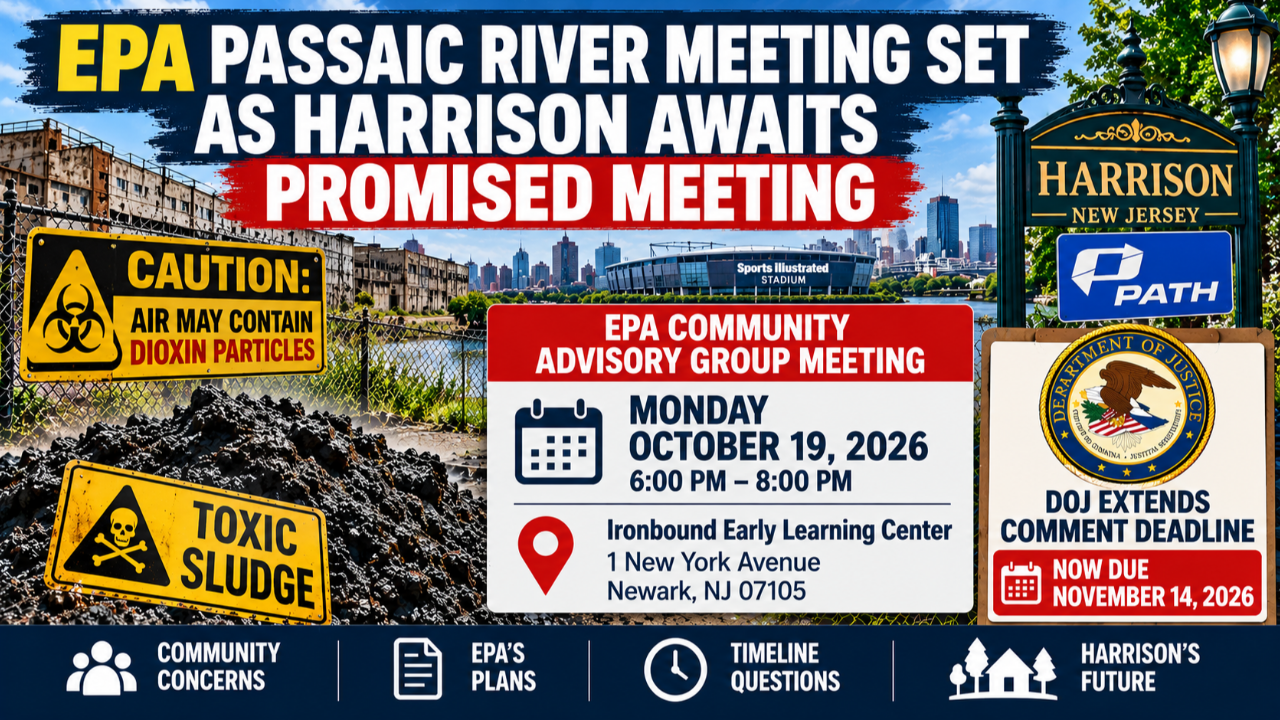
While the EPA has scheduled a Community Advisory Group meeting for Monday, October 19, 2026, in Newark, Harrison residents are still waiting for a second EPA public meeting in their own community, which EPA Project Manager Alice Yeh promised two years ago after the August 27, 2024, public meeting at Harrison High School.
That meeting brought together residents, elected officials, and EPA representatives to discuss plans for the former PSE&G property along the Passaic River.
Residents expressed concerns about the proposed sediment processing operation, particularly the potential release of airborne contaminants, including cancer-causing dioxin, truck traffic, noise, flooding, and the sludge plant's proximity to apartment buildings, the Harrison PATH Station, and the Northeast Railroad Corridor.
During the meeting, residents sought explanations of the cleanup plans, environmental safeguards, and why Harrison was selected as a location in what is now a residential community to process contaminated sediment.
EPA Project Manager Alice Yeh promised a second public meeting in Harrison to continue the discussion and address community concerns. More than two years later, that second EPA public meeting in Harrison has not taken place.
Next week’s meeting of EPA’s CAG will be held on Monday, October 19, 2026 with a 6 p.m. start at the Ironbound Community Center’s Ironbound Early Learning Center 1 New York Avenue, Newark, NJ. There is no indication of a Zoom session. Your Harrison will email subscribers with any updates on the meeting location and/or the addition of a Zoom option from EPA.
The absence of the promised follow-up meeting in Harrison raises questions about whether Harrison residents have received adequate opportunities for direct participation in decisions that could affect their community for years.
Although EPA representatives have participated in subsequent meetings elsewhere, including Passaic River Community Advisory Group meetings, those meetings are not necessarily a substitute for a dedicated public meeting in Harrison.
A meeting in Harrison would give residents living closest to the proposed facility a more convenient opportunity to question EPA officials, review technical information, and express concerns about the proposed operation.
The distinction matters because the federal government is now seeking approval of a consent decree that would advance construction of sediment processing infrastructure.
With the Department of Justice's comment deadline extended to November 14, 2026, residents may reasonably ask whether EPA intends to fulfill its commitment to hold another public meeting in Harrison before the comment period closes.
Residents attending Monday's CAG meeting in Newark can also ask EPA representatives about the status of the promised Harrison meeting and whether they will announce a date.
What Is the Passaic River Community Advisory Group?
CAG stands for Community Advisory Group.
The Passaic River Community Advisory Group was established in 2007 to give residents, environmental organizations, businesses, local governments, and other stakeholders a forum to discuss the cleanup and restoration of the Passaic River.
The group is intended to facilitate communication between EPA officials and communities affected by the Diamond Alkali Superfund Site, which includes contaminated portions of the Lower Passaic River.
Its purpose is to provide residents with information about cleanup proposals, allow them to ask questions, identify potential problems, and make recommendations concerning environmental remediation.
The CAG is an advisory organization. It has no independent legal authority to approve, reject, or modify EPA cleanup decisions.
Nevertheless, EPA guidance emphasizes that Community Advisory Groups should reflect the diversity of affected communities and provide meaningful opportunities for public participation.
A functioning CAG should help ensure that people most directly affected by cleanup operations can communicate their concerns to federal environmental officials.
What Federal Law Provides for Public Participation?
The legal foundation for public participation in Superfund cleanup decisions is the Comprehensive Environmental Response, Compensation, and Liability Act of 1980 (CERCLA), commonly known as the Superfund law.
Congress strengthened the law through the Superfund Amendments and Reauthorization Act of 1986. Section 117 of CERCLA, codified at 42 U.S.C. § 9617, establishes public participation requirements for certain federal cleanup decisions.
Under that provision, EPA must provide reasonable opportunities for the public to review proposed remedial plans and submit written and oral comments before finalizing covered cleanup remedies.
The statute also provides for public meetings, transcripts, and consideration of significant comments in final remedial decisions.
However, an important distinction exists between the public participation requirements established by Congress and EPA's Community Advisory Group program.
EPA organizes CAGs under its community involvement policies and guidance as an additional means of encouraging public participation.
EPA's Guidance for Community Advisory Groups at Superfund Sites, published in 1995, explains how to organize these groups, select members, and support public participation.
The guidance calls for CAGs to represent a broad range of community interests and give residents opportunities to communicate directly with EPA representatives.
Do Members of the Public Have the Right to Speak at CAG Meetings?
One of the most important questions for residents attending Monday's meeting is whether they will have an opportunity to speak, ask questions, and express concerns about the proposed cleanup.
EPA's 1995 Community Advisory Group guidance states:
"All CAG meetings should be open to the public."
The guidance also recommends that meetings provide opportunities for discussion and question-and-answer sessions involving members of the public in attendance.
A CAG's purpose is not simply to provide technical presentations to appointed members. It is to facilitate communication between EPA and the broader community.
Residents should therefore have meaningful opportunities to ask questions, present concerns, and communicate information relevant to cleanup decisions.
A key legal distinction also exists between a regular CAG meeting and a formal public meeting conducted under CERCLA Section 117.
EPA guidance makes clear that CAG meetings are intended to encourage community participation rather than exclude it.
Residents attending Monday's meeting should know there will be a designated public comment period and that EPA will record the meeting. Prior meetings are available for review online through this link.
Speaking at the CAG meeting does not automatically constitute submitting a formal written comment to the Department of Justice concerning the proposed consent decree.
Residents who wish to participate in the federal consent decree review should submit separate comments directly to DOJ before November 14, 2026, to the designated email (preferred method) and/or in writing following the requirement for a specific Re: language. See instructions here.
DOJ Extends Public Comment Deadline to November 14, 2026
The U.S. Department of Justice has extended the public comment period concerning the proposed federal consent decree involving Environmental Resource Holdings, LLC.
The original October 15, 2026, deadline has been extended by 30 days to Saturday, November 14, 2026. If you have submitted your comments, there is no need to resubmit them. If you want to supplement your comments, you may do so and submit additional comments.
The extension was formally announced in the Federal Register on October 5, 2026, under Document No. 2026-20288, at 91 Federal Register 63309.
The Department of Justice filed the proposed consent decree on September 10, 2026, in the United States District Court for the District of New Jersey in United States v. Environmental Resource Holdings, LLC, Civil Action No. 2:26-cv-11675.
The proposed agreement concerns initial remedial work for Operable Units 2 and 4 of the Diamond Alkali Superfund Site.
According to the Department of Justice, the agreement would require construction of an upland sediment processing facility and supporting infrastructure necessary for future dredging and capping operations in the Lower Passaic River.
The proposed processing facility would handle contaminated sediment dredged from the river before transporting it to off-site facilities for disposal.
The agreement also includes environmental sampling of the lower 8.3 miles of the Passaic River and reimbursement of certain EPA oversight costs.
The extension is particularly significant for Harrison because residents are being asked to comment on a federal agreement that could advance construction of the proposed processing facility before EPA has held the second public meeting previously promised to the community.
The additional 30 days give residents, community organizations, and municipal officials more time to review the proposed agreement, request information, and submit concerns directly to the federal government.
How to Submit Comments to the Department of Justice
The Department of Justice is accepting written public comments concerning the proposed consent decree through November 14, 2026.
Residents may submit their comments by email or regular mail.
Email is a convenient way to submit comments and supporting documents directly to the Department of Justice.
VIA EMAIL: [email protected]
RE: U.S. v. Environmental Resource Holdings, LLC, D.J. Ref. No. 90-11-3-07683/20
Residents should use the case identification and Department of Justice reference number published in the official Federal Register notice. Stated above for your convenience.
Comments submitted by regular mail should be addressed to:
Assistant Attorney General
U.S. Department of Justice
Environment and Natural Resources Division
P.O. Box 7611
Washington, DC 20044-7611
Deadline: Saturday, November 14, 2026.
The Department of Justice advises that written comments may be filed, in whole or in part, on the public federal court docket without additional notice to the commenter.
The proposed consent decree and related documents are available at:
https://www.justice.gov/enrd/consent-decree/us-v-environmental-resource-holdings-llc
Residents may submit comments concerning the proposed facility's location, environmental safeguards, public health risks, traffic, flood protection, air monitoring, alternative processing locations, and other matters related to the proposed agreement.
They may also raise concerns about the promised second EPA meeting in Harrison and ask federal officials to provide additional opportunities for public participation before the Department of Justice (DOJ) and the Federal Court Judge conduct their final review of the consent decree.
Why Harrison Residents Have a Particular Interest
The proposed sediment processing facility would occupy the former PSE&G property along the Passaic River, near the Harrison PATH Station, Sports Illustrated Stadium and a growing residential neighborhood.
The property is located in an area that has undergone substantial redevelopment, replacing former industrial uses with apartment buildings, commercial establishments, and public transportation improvements.
The site sits within the Harrison Redevelopment Zone and was earmarked for a public green space, a multi-level community center, and improvements to vehicle circulation and passenger drop-off near the PATH Station. It could also be incorporated into a flood control pumping station for the area in front of the Harrison PATH station.
Residents have questioned whether the proposed sediment-processing operation aligns with the Town's long-term redevelopment goals. Returning the Town of Harrison to its former industrial contaminated state is not in the Harrison Redevelopment Agency plan.
Concerns have also been raised about potential airborne emissions during the handling of sediment containing dioxins and other hazardous substances, as well as truck traffic, noise, flooding, and the proximity of the proposed facility to homes consisting of amenity-filled modern apartment buildings and public transportation (Harrison PATH, NJ Transit & Conrail’s Northeast Train Corridor).
EPA maintains that the Passaic River cleanup is necessary to reduce environmental and public health risks associated with contaminated sediment. But currently, the health risk in various forms, including cancer-causing dioxin, is encapsulated in sediment that, per EPA’s own statements at EPA meetings, is safely contained, as one EPA personnel stated; the sediment at he bottom of the Passaic River does a great job of holding the dioxin. Unless you eat the fish or crabs from the Passaic River, you currently can’t get sick from the sludge at the bottom of the Passaic River. You can get sick if the sludge is brought on land, squeezed to dewater it via a claw, and mixed with Portland Cement, especially if you are a short distance away (across the street) in your apartment in the Riverbend Section of Harrison, NJ.
However, residents questioning the Harrison location have asked whether the cleanup can be done at alternative processing sites farther from densely populated neighborhoods, such as the suggested industrial site in South Kearny, NJ, several miles from a residential community.
The dispute is not necessarily over whether the river should be cleaned, but rather where contaminated sediment should be processed and what safeguards should be required. The EPA plans to use a “vacuum” to move the contaminated sludge from the riverbed and place it in an enclosed barge-like ship to be transported, then by enclosed pipes (what other form of pipe is there?) to the yet-to-be-built Passaic Valley Sewarage Commission Sludge Plant in the Ironbound Section of Newark. EPA’s mission is to protect human health. An Open-Claw method in a residential community is unacceptable and should not even be considered by EPA’s Project Manager Alice Yeh. EPA cannot abandon its mission statement of protecting human health because open claw is cheaper.
How Long Would the Harrison Facility Operate?
Another unresolved concern is the proposed operation's duration.
At an August 29, 2022, Harrison Redevelopment Agency meeting, Mayor James Fife stated that EPA would use the PSE&G property for EPA-related operations for 10 years.
In subsequent public discussions, EPA representatives stated it would be used for 20 to 30 years.
Those broader estimates do not necessarily establish that the Harrison processing facility would operate continuously for the entire period.
Nevertheless, the project's potential duration remains an important issue for residents and property owners.
Questions remain about construction schedules, operating hours, truck movements, environmental monitoring, future restoration of the property, and when the land might again become available for the uses the Harrison Redevelopment Agency Plans intended.
These are matters that could be addressed at a dedicated EPA meeting in Harrison.
What Happens After November 14?
After the November 14 public comment deadline, the Department of Justice will review comments on the proposed consent decree.
Federal officials will then decide whether to proceed with the agreement as proposed or make changes.
The proposed consent decree requires approval by the United States District Court before becoming enforceable.
EPA has indicated that construction of cleanup-related facilities could begin in 2027 if the proposed agreement receives the necessary approvals.
The coming weeks therefore offer an important opportunity for residents to review the federal proposal and share their concerns with the Department of Justice. Some have already commented, as the deadline was originally Thursday, October 15, 2026.
A Meeting in Newark, but Harrison Still Awaits Answers
Monday's Community Advisory Group meeting gives residents of Harrison, Newark, Kearny, East Newark, and other affected communities a chance to learn more about the Passaic River cleanup and question EPA representatives.
The extension of the federal public comment deadline makes the meeting especially timely. But for Harrison residents, another issue remains unresolved.
EPA Project Manager Alice Yeh promised a second public meeting in Harrison following the August 27, 2024, meeting at Harrison High School. More than two years later, that meeting has not occurred. Attending a meeting in the Ironbound Section of Newark at the Ironbound Community Corporation property at 1 New York Avenue, Newark, NJ, isn't ideal, given there is no parking lot and street parking is difficult. The building is nice, but if the number of people who showed up at the 2024 Harrison EPA meeting is representative, the room the meeting is usually in won’t be able to accommodate everyone.
As the federal government moves toward approving a consent decree that would advance construction of contaminated sediment processing facilities, residents have reason to seek clarification on when EPA intends to fulfill its commitment to an additional Harrison EPA meeting.
The Community Advisory Group provides a valuable forum for regional discussion, but Harrison residents have a particular interest in receiving detailed information about a facility proposed for their own community.
The public comment extension gives residents more time to review the agreement, ask questions, and submit concerns.
EPA has not yet answered whether it will return to Harrison for the promised second public meeting before November 14.
Residents attending Monday's meeting can raise that question directly with EPA representatives while also seeking answers about the proposed facility's location, environmental safeguards, operating duration, and potential effects on surrounding neighborhoods.
The Passaic River cleanup is a major environmental undertaking that will affect communities for years to come.
Ensuring those communities have meaningful opportunities to participate is essential to the process.
Residents who want their concerns considered during the federal consent decree review should submit written comments to the Department of Justice by November 14, 2026.
Additional information: Meeting schedules and CAG information are available at www.passaiccag.org. The proposed consent decree and official comment instructions are available at www.justice.gov/enrd/consent-decrees
Submit An Article