Write-In Challengers Confront Steep Odds Mayor Fife & Incumbents Win
Nov 04, 2026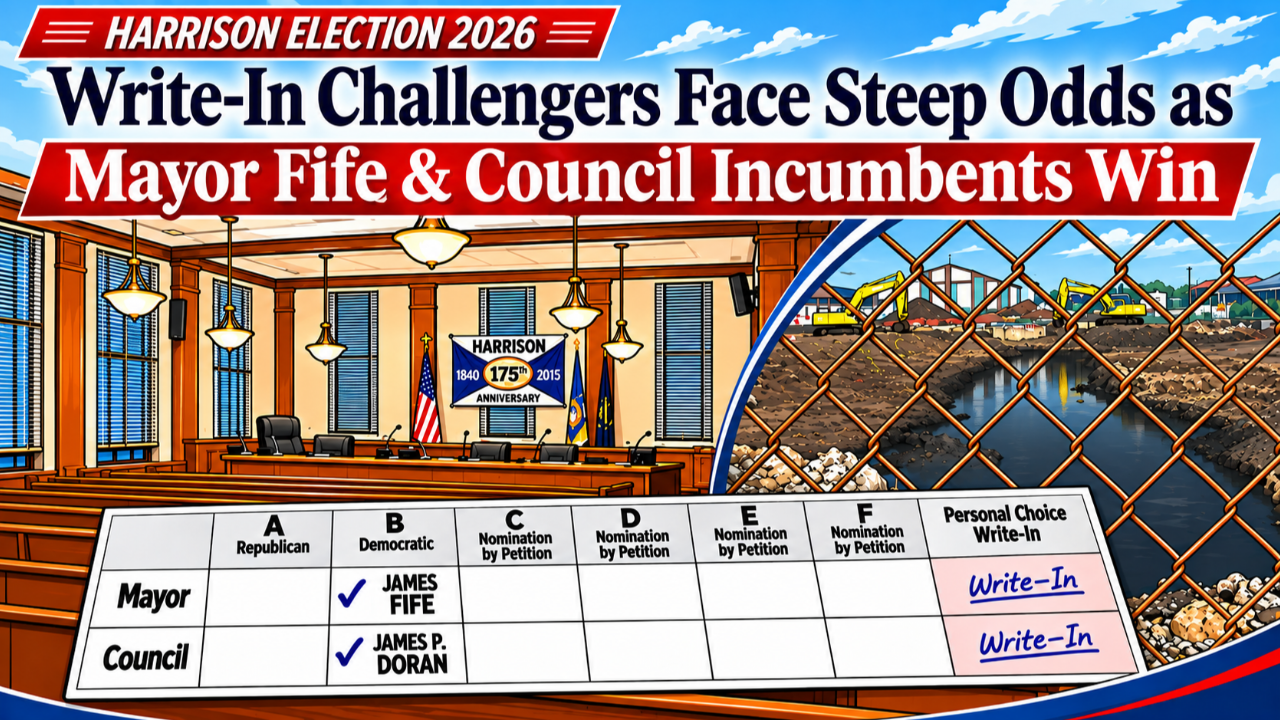
Harrison's November 3 election draws just 33.58% of registered voters. A contested signature requirement, unsuccessful court challenges, and a last-minute write-in campaign raise questions about ballot access, political competition, and the town's future.
Mayor James A. Fife and the four candidates for Harrison Town Council emerged victorious in Tuesday's General Election, according to the Hudson County election results spreadsheet, following a campaign marked by a dispute over ballot access, environmental concerns surrounding the proposed Passaic River dredging operation bringing a Toxic Sludge Plant to the PSE&G property in Harrison, and an unusual effort by four residents to challenge the established political leadership through write-in votes.
The election results tell two stories. The first is the electoral success of Mayor Fife and Council candidates Jesus Huaranga, Joseph Diaco, James Woods, and James Doran. The second concerns the difficulty of mounting a write-in campaign after candidates have been denied placement on the printed ballot.
For mayoral challenger Michael Verile and First Ward challenger Dominick Ritorto, the election followed an unsuccessful legal effort to restore their names to the ballot after they relied on inaccurate written information from the Hudson County Clerk's Office concerning the number of petition signatures required.
Rather than abandon their campaigns, Verile and Ritorto continued as write-in candidates, joined by Steven Landfield in the Second Ward and Ki Sau Chan in the Third Ward.
Their campaign raised questions about government transparency, environmental protection, and how New Jersey courts should handle misinformation provided by election officials.
Harrison voter turnout: Nearly two-thirds of registered voters did not vote
Registered voters
9,628
Ballots cast
3,233
Voter turnout
33.58%
Participation among registered voters
6,395 did not vote
The figures reveal that 6,395 registered Harrison voters did not participate in the election, representing 66.42% of the registered electorate.
Turnout by Harrison Wards
|
Harrison ward |
Registered voters |
Ballots cast |
Turnout |
|
First Ward |
1,919 |
603 |
31.42% |
|
Second Ward |
2,958 |
933 |
31.54% |
|
Third Ward |
2,580 |
938 |
36.36% |
|
Fourth Ward |
2,171 |
759 |
34.96% |
|
Town total |
9,628 |
3,233 |
33.58% |
Percentage of registered voters who cast ballots, November 3, 2026.
The Third Ward recorded the highest participation, at 36.36%, while the First Ward recorded the lowest, at 31.42%.
The election records also show how residents cast their ballots: 2,242 voted on Election Day, 699 participated in early in-person voting, 286 voted by mail, and six ballots were recorded in the overseas category. The spreadsheet records no provisional ballots. It is unclear whether any provisional ballots were cast.
These figures matter especially when considering the write-in candidates' efforts. A campaign attempting to unseat an established administration must not only persuade voters to support an alternative candidate but also motivate residents to participate in the election.
Election results: Fife and council candidates receive overwhelming majorities of recorded votes
|
Office |
Printed-ballot candidate |
Candidate votes |
All write-in votes |
|
Mayor |
James A. Fife |
2,479 |
281 |
|
First Ward |
Jesus R. Huaranga |
448 |
64 |
|
Second Ward |
Joseph Diaco |
777 |
50 |
|
Third Ward |
James T. Woods |
686 |
61 |
|
Fourth Ward |
James P. Doran |
600 |
19 |
The mayoral race produced 2,760 recorded votes, including 281 write-in votes. Fife received 89.82% of the votes recorded in that contest, compared with 10.18% recorded as write-ins.
An important distinction: the election spreadsheet does not identify the individual recipients of the write-in votes. The 281 mayoral write-in votes cannot automatically be attributed to Michael Verile, nor can all ward-level write-in votes be attributed to the Stand Up Harrison candidates. Individual write-in tallies would be needed to establish their actual vote totals.
The difference between the number of residents casting ballots and the number voting in the mayoral contest also deserves attention. Although 3,233 Harrison residents voted, only 2,760 votes were recorded in the mayoral race. A difference of 473 ballots. That difference may reflect voters who skipped the mayoral contest or other ballot-accounting categories and should not be treated as votes for either candidate.
The same distinction applies to the ward contests.
How difficult is it to win an election as a write-in candidate?
The Stand Up Harrison candidates faced an obstacle that goes well beyond ordinary political campaigning.
Their opponents' names appeared directly on the ballot. The write-in candidates' names did not.
To support a write-in candidate, voters had to locate the appropriate contest on the ExpressVote XL touchscreen voting machine, select the Personal Choice or Write-In option, enter the candidate's name, and complete the voting process.
That additional procedure creates a practical disadvantage. A voter may know the candidate but forget the exact name, overlook the write-in option, or decide to vote only in contests with printed names.
No reliable national percentage shows how often write-in candidates win municipal elections. Nevertheless, American political history offers examples of successful campaigns.
In 1954, Strom Thurmond won a United States Senate election in South Carolina as a write-in candidate, receiving approximately 63% of the vote. The United States Senate's official history identifies him as the first person elected to the Senate through a general-election write-in campaign.
U.S. Senate
In 2010, Alaska Senator Lisa Murkowski won reelection through a write-in campaign after losing her party's primary. Her victory required extensive voter education, name recognition, and a statewide organization that could teach voters how to cast their ballots.
These examples demonstrate that winning as a write-in candidate is possible, but they are unusual and involved political circumstances substantially different from those in Harrison.
In Harrison, the write-in challengers had to overcome the advantages of established officeholders and a political organization while communicating the mechanics of write-in voting.
Their efforts also occurred against the backdrop of limited voter participation.
The election results do not establish how many voters knew about the write-in campaign, how many attempted to vote for its candidates, or whether any write-in votes were rejected because of spelling or other issues.
Answering those questions requires a more detailed review of the write-in records.
The ballot-access controversy: Candidates relied on incorrect information from election officials
One of the most consequential stories of the 2026 Harrison election began months before Election Day.
The controversy centered on information the Hudson County Clerk's Office provided about the number of signatures required for independent candidates to appear on the November General Election ballot.
Your Harrison, in preparation for a story on how to run in the November General Election, requested in writing the number of minimum signatures required to run for Mayor & Council in Harrison for Mayor & Council
The response came from Amber Vargas, the Supervisor of Elections in the Hudson County Clerk's Office.
Hudson County Clerk E. Junior Maldonado was copied on the email correspondence.
The information supplied was subsequently determined to be incorrect, and the dispute became the subject of litigation involving Dominick Ritorto and Michael Verile.
What the candidates were told
The published record contains differing accounts of the precise number of incorrect mayoral signatures: 50. Mayor James Fife and Councilman Jesus Huaranga, through the Town of Harrison counsel, challenged the Michael Verile and Dominick Ritorto election petition, stating that the minimum number of signatures was 161 signatures for Mayor and 31 for First Ward Council. The two offices sought. Interestingly, based on the initial information Amber Vargas provided to Your Harrison, the Second Ward required 25 signatures, whereas the other three wards required only 10 signatures per council to be placed on the ballot.
The following comparison reflects the July 20 YourHarrison reporting:
|
Office |
Reported incorrect guidance |
Requirement applied in litigation |
|
Mayor |
50 signatures |
161 signatures |
|
First Ward Council |
10 signatures |
31 signatures |
The central issue, however, does not depend solely on that discrepancy.
Both candidates maintained that they relied on information originating from election officials when deciding how many signatures to collect.
The Hudson County Clerk's Office did not initially reject the Verile & Ritorto petitions. Amber Vargas of the Hudson County Clerk’s Office subsequently rejected the petitions after Mayor Fife & Councilman Huaranga, through Town of Harrison Counsel, filed an objection to the Petitions on the grounds that they lacked the necessary signatures.
The candidates argued that they should not lose their opportunity to appear on the ballot after relying on inaccurate guidance from the government office administering the election.
The County Counsel, representing the Hudson County Clerk’s office, took a different legal position, maintaining that statute established the requirements and that candidates were responsible for meeting them. The inaccuracy of the information did not matter under the statute.
A court ruling that left questions unanswered
Hudson County Assignment Judge David Katz heard the litigation.
According to the New Jersey Globe's account of the proceedings, Katz dismissed the candidates' challenges on two principal grounds: the petitions did not contain sufficient valid signatures, and the court challenges were filed three days after the statutory deadline.
The ruling meant that neither candidate would appear on the printed ballot.
But one aspect of the dispute deserves further attention. Judge Katz decided the case on an expedited basis with stipulations submitted by both sides. Amber Vargas was not called to testify in the Harrison litigation, although she testified in a prior case also involving the Hudson County Clerk’s office providing inaccurate minimum signature requirements for a Hudson County Commissioner. The parties stipulated that the Hudson County Clerk's office provided an incorrect number of signature numbers.
Consequently, the proceedings did not include sworn testimony from Vargas explaining how she calculated the numbers she supplied, why the information was incorrect, or whether procedures existed to correct inaccurate guidance before the filing deadline.
The court ruled on the legal sufficiency of the petitions and the timeliness of the challenges. It did not conduct a full evidentiary inquiry into the administrative process that produced the erroneous guidance.
For the candidates, the consequences were substantial. They could not compete with their names printed alongside those of the incumbent administration's candidates.
Nevertheless, they continued their political efforts.
The candidates' decision to continue as write-ins
Verile and Ritorto's response to the unsuccessful litigation became an important part of the election story.
Both could have ended their campaigns after the court ruling.
Instead, they helped organize a write-in slate that also included Steven Landfield and Ki Sau Chan.
Their decision preserved an alternative choice for Harrison voters, although it required a substantially different form of campaigning.
The Stand Up Harrison candidates had to introduce themselves to residents, explain their positions on municipal issues, and teach voters how to cast write-in ballots.
Their campaign emphasized government accountability and greater public involvement in decisions affecting Harrison's future.
The campaign did not produce an electoral victory, but it placed several issues before voters that will continue beyond Election Day.
The emergency appeal: Was the Appellate Division required to hear the election dispute immediately?
Following the trial court's ruling, Verile and Ritorto pursued an emergent application in the New Jersey Appellate Division, representing themselves pro se.
The appellate judge declined to treat their application as an emergent matter.
That raises an important legal question: How can a dispute involving ballot placement, ballot printing, and voting-machine programming fail to qualify for emergency consideration when delay may eliminate the opportunity for meaningful relief before an election?
Your Harrison plans to explore in a future article how New Jersey’s judiciary plays an important role in elections, including how it resolves election disputes that come before it.
Your Harrison Is Your Community — Join the Conversation
Local news is better when the community is part of it. After reading this article, tell your neighbors what you think, share information, ask questions, or start a discussion on the Community Discussion Board.
Not a member yet? Joining Your Harrison is free. Join a growing community of residents, former residents, local business owners, and others who care about what is happening in Harrison and West Hudson.
Join Your Harrison FREE today, then add your voice to the conversation.
Submit An Article