Oppose Harrison Toxic Sludge Plant: DOJ Deadline Sat. Nov. 14, 2026
Nov 11, 2026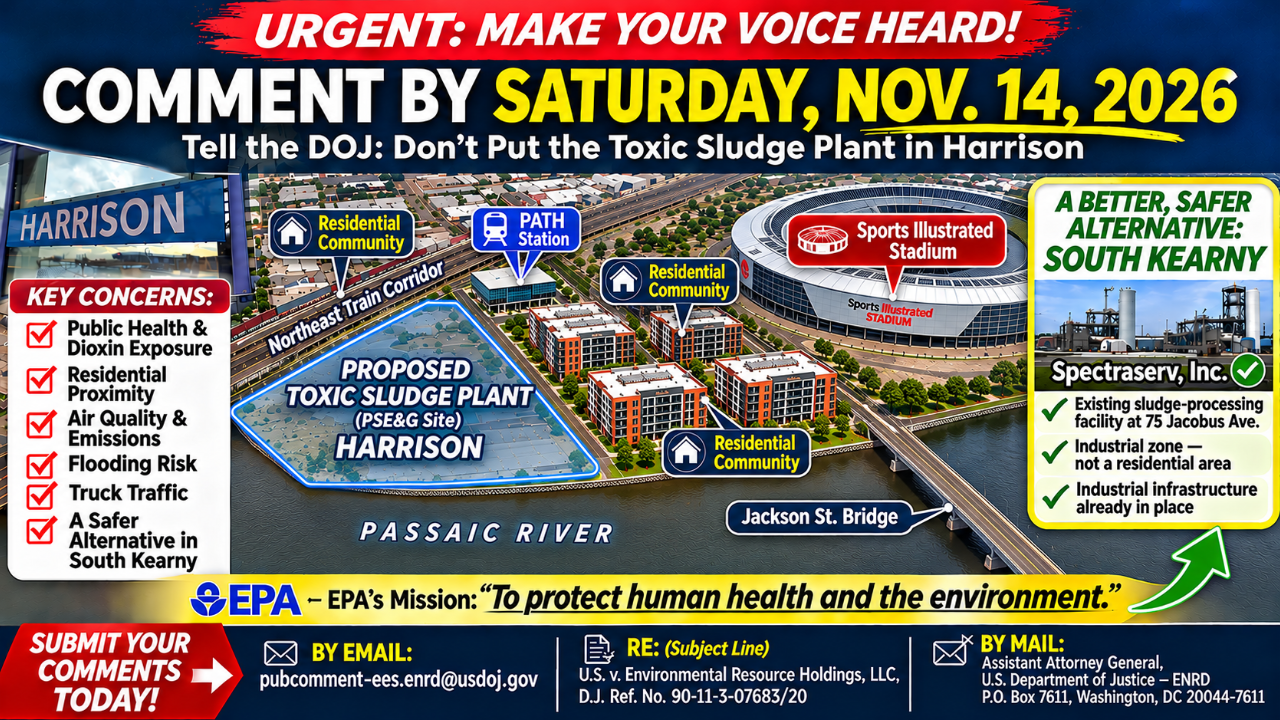
South Kearny already has industrial sludge-processing operations. Harrison residents can demand that EPA evaluate safer alternative locations before moving forward with a contaminated-sediment facility near homes, the PATH station, and Sports Illustrated Stadium.
Wednesday, November 11, 2026, Veterans Day—On the 11th Day of the 11th Month at the 11th Hour, this article was published. Harrison residents have only three days remaining to submit comments to the United States Department of Justice (DOJ) concerning a proposed federal consent decree that could advance construction of a toxic sediment-processing facility on PSE&G property along the Passaic River, immediately adjacent to Harrison's growing residential redevelopment district.
The public comment deadline is Saturday, November 14, 2026, following a 30-day extension of the original October 15 deadline.
At the center of the controversy is a fundamental question: Why place a facility that would process dioxin-contaminated river sediment next to and surrounded by residential apartment buildings, the Harrison PATH station, and Sports Illustrated Stadium when industrial alternatives exist in nearby South Kearny, where sludge-processing facilities already operate?
The Environmental Protection Agency's stated mission is to protect human health and the environment. That responsibility should be central to determining where the contaminated sediment will be processed.
Residents who oppose the Harrison location can submit written comments requesting that DOJ reconsider the proposed site, require a thorough comparison with alternative industrial locations, and ensure public-health protections are in place before the federal court approves the agreement.
Information on how to email your comments/objections is below. You can scroll down to find the email address and a sample objection you can modify to be your own. Please submit a comment. It is important for the future of the residents of the Town of Harrison. You don’t have to be a resident to submit a comment.
What Is the Federal Government Proposing?
On September 10, 2026, the Department of Justice filed a proposed consent decree in the United States District Court for the District of New Jersey in United States v. Environmental Resource Holdings, LLC, Civil Action No. 2:26-cv-11675.
The agreement concerns initial cleanup work for Operable Units 2 and 4 of the Diamond Alkali Superfund Site, which includes contaminated portions of the Lower Passaic River.
The proposed settlement would require Environmental Resource Holdings, LLC, to undertake work to construct an upland sediment-processing facility and the infrastructure needed for future dredging and capping operations.
The work would also include environmental sampling and reimbursement of certain EPA oversight expenses.
EPA has described the settlement as an important step toward addressing the hazardous contamination that has affected the Passaic River for decades.
However, cleaning the river does not resolve the separate question of where contaminated sediment should be processed.
The Harrison proposal would bring contaminated material from the river to an upland processing operation on PSE&G property near a densely populated residential neighborhood. On three sides of the PSE&G property (2 are over rail lines but basically equidistant)
Residents have raised concerns about how sediment containing dioxins and other hazardous substances would be handled, dewatered, mixed with stabilizing Portland Cement materials, temporarily stored, and transported for disposal.
Those concerns are particularly important because the final facility design, containment measures, and site-specific operating safeguards have not been fully explained to the Harrison community. Those designs haven’t even been drafted. EPA’s Project Manager Alice Yeh has stated that the contractor will be in charge of the plant’s design.
Dioxin Is a Known Carcinogen — Why Risk Exposure Near Homes?
The Lower Passaic River contains hazardous substances associated with historical industrial pollution, including dioxins, PCBs, pesticides, mercury, and other contaminants.
Among the substances of concern is 2,3,7,8-tetrachlorodibenzo-p-dioxin, commonly known as TCDD, a particularly toxic form of dioxin recognized as a human carcinogen.
The contamination is partly associated with historical chemical manufacturing at the Diamond Alkali facility in Newark.
The danger presented by contaminated sediment depends on how people may be exposed to it. Sediment lying beneath the river and sediment being excavated, handled, processed, and transported present different potential exposure pathways.
Removing contaminated material from the river is intended to reduce long-term environmental and public-health risks. Nevertheless, the cleanup process itself must be designed to prevent unacceptable exposure. The sludge at the bottom of the river is not a danger to human health unless you eat crabs and fish from the Passaic River. It is very clear that EPA did nothing; the toxic sludge in the river would not be a danger to human health unless you eat crabs and fish from the Passaic River. Does anyone you know do that?
Residents are particularly concerned about whether contaminated dust or aerosols could escape during open-air handling, mechanical dewatering, mixing with Portland cement, loading, or transportation. EPA Project Manager Alice Yeh said it was safe because it would be wet. What she did not say is that, if it dries, it is highly toxic to human health and microscopic in size, so you would not even know you breathed it.
If contaminated particles become airborne, the potential for off-site exposure must be assessed using the actual proposed equipment, operating conditions, weather patterns, and distances to surrounding buildings.
It would be inappropriate to dismiss residents' concerns without demonstrating that the proposed controls will adequately protect them.
EPA should publicly disclose the engineering design, air-dispersion modeling, monitoring requirements, containment measures, and emergency shutdown procedures before the Harrison facility advances.
Or better yet, place the proposed Harrison Toxic Sludge Plant in industrial South Kearny and resident fears would be allayed
Harrison's Riverbend District Is a Residential Community, Not an Industrial Processing Zone
The proposed PSE&G location sits in the very successful and vibrant Harrison Redevelopment Zone, which has been transformed over 27 years from an abandoned, contaminated industrial zone into its present residential zone.
The Riverbend district contains large residential apartment communities, commercial establishments, restaurants, pedestrian walkways, and the Harrison PATH station.
Thousands of residents, commuters, and visitors use the surrounding area.
Sports Illustrated Stadium, home to the New York Red Bulls and NJ/NY Gotham FC, also attracts substantial crowds for professional sporting events and concerts.
The proximity of these uses raises questions about whether the proposed facility's location is appropriate for processing hazardous river sediment.
Residents living in nearby apartment buildings may spend considerable time outdoors on balconies, terraces, and sidewalks. Commuters pass through the neighborhood daily, and stadium events can bring large numbers of additional visitors. It is currently home to the New York Red Bulls and the NJ/NY Gotham FC professional soccer teams. The band Metallica recently held back-to-back sold-out concerts (25k fans) at the stadium (Sports Illustrated Stadium).
A meaningful human-health assessment should account for these populations rather than evaluating the proposed operation as though it were situated in an isolated industrial area.
The Harrison Redevelopment Agency's long-term vision for the southern portion of town has emphasized residential, commercial, transportation, and community-oriented development.
Introducing a contaminated-sediment processing operation into that environment raises legitimate land-use and public-health questions that deserve detailed answers.
South Kearny Offers an Industrial Alternative That EPA Should Evaluate
One of the strongest questions Harrison residents can raise with DOJ is whether EPA adequately evaluated industrial locations in nearby South Kearny before selecting the PSE&G property.
South Kearny contains extensive industrial areas used for manufacturing, warehousing, transportation, waste management, and other industrial operations.
Unlike Harrison's residential redevelopment district, portions of South Kearny are specifically zoned for industrial activities.
The area has industrial transportation infrastructure and properties that may warrant evaluation for contaminated-sediment processing.
This does not mean that every industrial parcel would be suitable. Any alternative would require engineering studies, environmental permitting, transportation planning, flood-risk analysis, and an assessment of nearby populations.
However, the existence of an industrial district relatively close to the Passaic River raises an important question:
Has EPA demonstrated that processing contaminated sediment near Harrison's residential apartment buildings is preferable to locating the operation in an established industrial area?
Spectraserv Already Operates a Sludge-Processing Facility in South Kearny
An important example of existing industrial sludge-processing activity is Spectraserv, Inc., which operates a facility at 75 Jacobus Avenue in South Kearny.
Spectraserv is an established environmental-services company involved in sludge processing, dewatering, and waste management.
According to the company's published description of its Kearny operations, the facility includes two belt filter presses, a bioscrubber, and a waste-transfer station operating under New Jersey Pollutant Discharge Elimination System Permit No. NJ0079570.
The facility receives liquid residuals, processes sludge through dewatering equipment, and arranges for transportation of processed material to approved off-site facilities.
The company also handles municipal sludge, grit, and screenings.
Spectraserv's existing South Kearny operation demonstrates that industrial sludge-management activities are already conducted in that area.
It does not establish that Spectraserv is authorized or equipped to handle Diamond Alkali Superfund sediment containing dioxins, or that the existing facility could accommodate the proposed EPA project without substantial changes.
Nevertheless, it is relevant to the broader question of whether an established industrial area with existing waste-management infrastructure offers potential advantages over a residential redevelopment district.
DOJ should require EPA to disclose whether it evaluated Spectraserv's location, nearby industrial properties, or other South Kearny sites as possible alternatives to Harrison.
The question is not whether Spectraserv itself must operate the facility. The question is whether EPA has sufficiently investigated suitable industrial locations where contaminated-sediment processing could be conducted farther from concentrated residential development.
The presence of an existing sludge-processing operation makes South Kearny a concrete area for further investigation, not a purely hypothetical alternative.
Protecting Human Health — Not Simply Reducing Costs — Must Be EPA's Priority
The Environmental Protection Agency states its mission plainly:
EPA's mission is to protect human health and the environment.
That mission should guide every major decision associated with the Lower Passaic River cleanup, including the location of the sediment-processing facility.
Cost is a legitimate consideration in environmental remediation. Federal agencies must evaluate construction expenses, transportation requirements, operating efficiency, engineering feasibility, and the overall use of available cleanup funds.
But financial considerations cannot substitute for demonstrating that a selected location adequately protects human health.
If processing contaminated sediment at an industrial location in South Kearny would cost more than processing it in Harrison, the additional expense should be considered alongside any potential reduction in exposure risks to residents, commuters, and visitors.
The public deserves to know whether cost was a significant factor in selecting the Harrison location and whether alternative locations were rejected because of expense, engineering limitations, transportation requirements, or environmental concerns.
The least expensive location is not necessarily the location that best protects human health.
DOJ should require a documented comparison of feasible alternatives, including the potential costs and public-health consequences of each.
The federal government should be able to demonstrate that the proposed Harrison location satisfies EPA's health-protection mission, rather than asking residents to accept assurances without reviewing the supporting evidence.
Flooding Near the PATH Station Creates Additional Concerns
The proposed PSE&G site is located along the Passaic River in an area where stormwater drainage and flooding have been persistent concerns.
Residents have documented flooding near the Harrison PATH station, including water emerging from street infrastructure during significant rain events.
Those conditions raise questions about how contaminated sediment, processing equipment, temporary storage areas, and stormwater systems would be protected during severe weather.
If contaminated sediment is brought onto land for processing, the facility must have adequate measures to prevent contaminated material or process water from escaping during flooding. The proposed Harrison Toxic Sludge Plant will be an open-air plant. In other words, the toxic dioxin sludge will not be processed in an enclosed building with air filtration or other protections to the surrounding community.
Residents should ask DOJ to require disclosure of the proposed flood-protection design, stormwater management plan, secondary containment measures, and emergency response procedures.
The comparison between Harrison and potential South Kearny locations should include flood exposure at both sites.
An industrial alternative would only be preferable if its overall risks could be adequately controlled.
Harrison Residents Are Still Waiting for Another EPA Public Meeting
EPA held a public meeting at Harrison High School on August 27, 2024, where residents expressed concerns about the proposed processing facility.
According to previous YourHarrison reporting, EPA Project Manager Alice Yeh indicated that another in-person public meeting would be held in Harrison.
More than two years later, that promised meeting has not taken place.
EPA has continued to conduct Lower Passaic River Community Advisory Group (EPA CAG) meetings, including meetings outside Harrison and virtual sessions.
However, those meetings do not eliminate the need for meaningful public engagement in the municipality that would host the proposed processing facility.
Residents should have an opportunity to examine the facility's proposed design, ask questions of engineers and public-health specialists, and receive direct answers about containment, emissions, flooding, transportation, and alternative locations.
DOJ should consider whether the public has been provided sufficient technical information to evaluate the proposed consent decree before federal court approval.
To date, as one attendee at the Harrison EPA Toxic Sludge Plant meeting stated over two years ago, there are no specifics, only a general statement without details.
What Happens to Harrison's Plans for a Park and Community Center?
The PSE&G property remains in active use for vehicle parking, supply storage, and other utility operations.
Historically, the property was used for manufactured-gas production and storage. PSE&G subsequently dismantled the large gas-storage tanks and conducted environmental cleanup work.
The Harrison Redevelopment Agency had “planned”, as Harrison Mayor & Chairman of HRA put it, a different future for the site, including public green space, a multilevel community center, and improvements to vehicle circulation and passenger drop-off facilities serving the Harrison PATH station. Recently, it was revealed by a candidate running for office, Steven Landfield, who lives across the street from the proposed EPA Toxic Sludge plant in the Steelworks apartment building, a pumping station designed by Hudson County engineers is being held up by EPA’s plan to put a Toxic Sludge Plant at PSE&G. Another detail Mayor Fife’s administration has failed to tell residents.
These improvements would provide recreational opportunities, public amenities, and transportation benefits for a growing residential population.
The proposed sediment-processing facility raises questions about how long the property would be occupied by cleanup-related operations and when it could become available for other uses.
Previous statements about the anticipated duration of the proposed Harrison operation have varied, with publicly discussed estimates ranging from approximately 10 to 20 years and 30 years, depending on who is answering the question on behalf of EPA.
Residents should request an enforceable schedule identifying when processing would begin, the anticipated duration of operations, when equipment would be removed, and what environmental restoration would be required before the property could be used for other purposes.
The proposed consent decree should not leave Harrison residents uncertain about the long-term future of a strategically important property near the PATH station.
Residents Have Until Saturday to Submit Comments to DOJ
The Department of Justice extended the public comment period from October 15 to November 14, 2026, providing residents an additional 30 days to review the proposed consent decree and submit objections or requests for additional safeguards.
The extension was published in the Federal Register on October 5, 2026, as Document No. 2026-20288, at 91 Federal Register 63309.
Residents who have already submitted comments do not need to submit them again. However, they may provide supplemental comments or additional supporting documentation before the deadline.
The Department of Justice can consider comments concerning the proposed agreement, including whether its provisions adequately protect public health and the environment.
Submitting a comment does not guarantee that DOJ will change the agreement or reject the Harrison location. Nevertheless, written submissions allow residents to raise specific concerns for consideration during the federal review process.
How to submit comments
Public comment deadline
Saturday, November 14, 2026
Email comments to:
Please note that the RE: line must be as shown below, including the Ref. No. 90-11-3-07683/20
If you don’t email with the RE: as stated below, your comment may not be considered.
Sample Email / Letter:
RE: United States v. Environmental Resource Holdings, LLC, D.J. Ref. No. 90-11-3-07683/20
Dear Assistant Attorney General:
I am submitting comments concerning the proposed consent decree in United States v. Environmental Resource Holdings, LLC, involving the cleanup of the Lower Passaic River.
I support removing hazardous contamination from the Passaic River. However, I object to proceeding with the proposed sediment-processing facility on PSE&G property in Harrison, New Jersey, without a comprehensive and publicly available demonstration that this location will adequately protect nearby residents, commuters, workers, and visitors.
The proposed site is close to residential apartment buildings, the Harrison PATH station, and Sports Illustrated Stadium.
I request that DOJ require EPA to evaluate alternative industrial locations in South Kearny, where sludge-processing operations already exist, including Spectraserv's facility at 75 Jacobus Avenue. The presence of this established industrial infrastructure warrants serious examination of whether a suitable location farther from concentrated residential development could reduce potential public-health risks.
EPA should publicly disclose its comparative site-selection analysis, including the health, environmental, engineering, transportation, and cost considerations used to select Harrison.
I also request disclosure of the proposed facility's engineering plans, containment measures, air-monitoring requirements, flood-protection systems, emergency procedures, and anticipated operating duration.
EPA's stated mission is to protect human health and the environment. Cost considerations should not override that responsibility.
Finally, I request that EPA hold another in-person public meeting in Harrison so residents can question technical experts about the proposed facility and its potential impacts.
I respectfully ask DOJ to withhold consent to entry of the proposed decree unless these issues are adequately evaluated and necessary safeguards are made enforceable.
Sincerely,
[Your Name]
[Your Municipality, New Jersey]
[end of sample email. Please make the email your own thoughts and objections]
The Passaic River Needs Cleaning — But Harrison Residents Deserve Protection Too
There should be no disagreement about the importance of cleaning the contaminated Lower Passaic River.
For decades, industrial pollution has affected the river, its ecosystems, and communities along its banks.
The cleanup is intended to address that environmental damage and reduce long-term risks associated with hazardous sediment.
But a successful cleanup must protect people not only from contamination remaining in the river, but also from unacceptable exposure during dredging, processing, and disposal.
The existence of established industrial sludge-processing operations in South Kearny makes it especially important for EPA to explain why Harrison's residential redevelopment district was selected.
If South Kearny or another industrial location would provide equivalent cleanup effectiveness with lower risks to surrounding populations, that alternative deserves serious consideration, even if it involves additional costs.
EPA's responsibility is to protect human health and the environment. The selection of a sediment-processing location should reflect that responsibility.
The November 14 deadline gives Harrison residents a limited remaining opportunity to place their concerns directly before the Department of Justice.
The central question remains:
Why should contaminated sediment be processed next to Harrison's residential neighborhood if a suitable industrial alternative could better protect human health?
Federal officials should be prepared to answer that question with scientific evidence, engineering studies, and a transparent comparison of feasible locations before the proposed consent decree receives final approval.
As local attorney John Pinho has asked EPA personnel without a good answer, “Where else in the United States of America has EPA placed a Toxic Sludge Plant in a residential community?”
Let’s hope the answer to the latter question is not in the future: Harrison, NJ, USA.
Your Harrison Is Your Community — Join the Conversation
Local news is better when the community is part of it. After reading this article, tell your neighbors what you think, share information, ask questions, or start a discussion on the Community Discussion Board.
Not a member yet? Joining Your Harrison is free. Join a growing community of residents, former residents, local business owners, and others who care about what is happening in Harrison and West Hudson.
Join Your Harrison FREE today, then add your voice to the conversation.
Submit An Article