Lied To Harrison Residents & Developers Face Reality of Toxic Sludge
Sep 16, 2026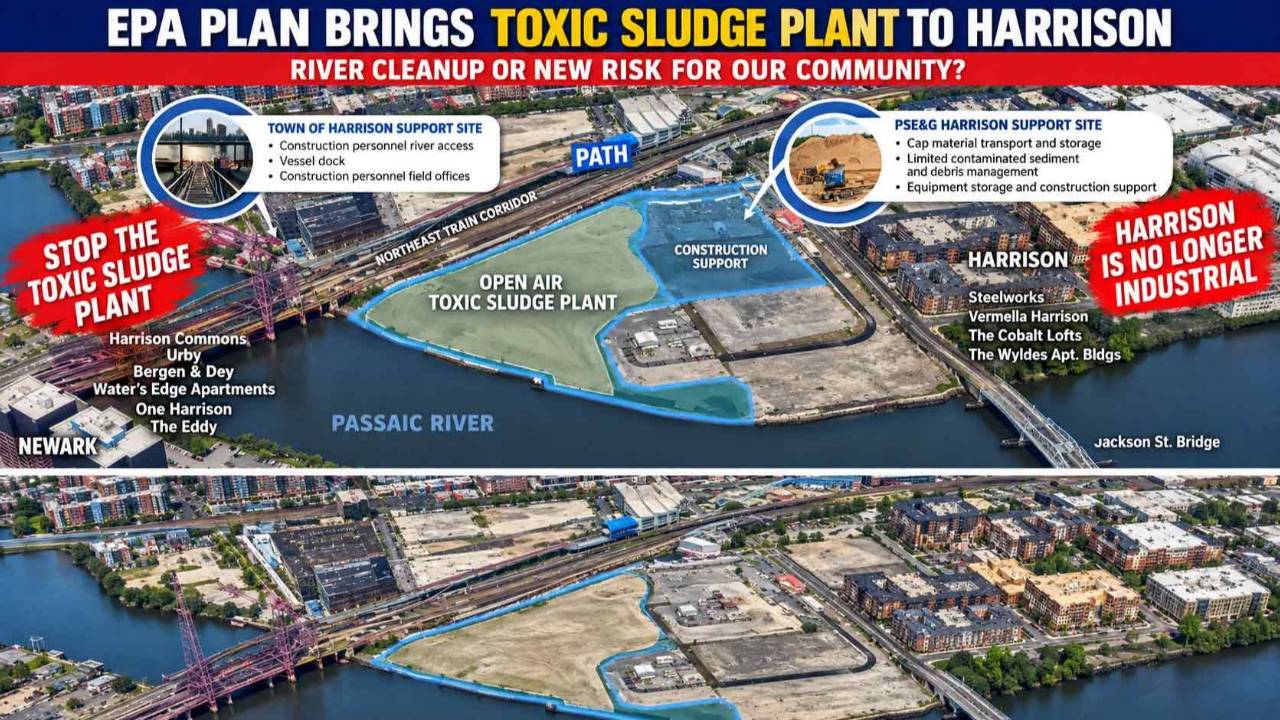
The U.S. Environmental Protection Agency and Department of Justice have announced a proposed agreement intended to move the massive Lower Passaic River Superfund cleanup closer to construction.
EPA describes the agreement as an important step toward dredging and capping contaminated sediment from the river. Under the proposed consent decree, Environmental Resource Holdings LLC, or ERH, would perform work estimated at approximately $125 million, including construction of an upland processing facility and several upland support facilities needed for the cleanup. ERH is going to put Toxic Sludge in the PSE&G property in Harrison that PSE&G spent an estimated $367 to $400 million dollars to clean up. Does it make any sense to contaminate a property that has been environmentally cleaned up across from a residential community that was also cleaned up?
At first glance, requiring companies connected to generations of industrial pollution to help pay to clean the Passaic River may seem like an environmental success.
For Harrison residents, however, the issue is considerably more complicated.
The cleanup would take contamination that is presently encapsulated in sediment at the bottom of the Passaic River, dredge and disturb that material, and move portions of the operation onto land near a densely populated section of Harrison that has spent almost 30 years transforming itself from a contaminated industrial district into a residential and transit-oriented community.
The EPA cleanup design specifically identifies the former PSE&G property in Harrison as a location for a Upland Support Facility, or USF. EPA loves abbreviations. It also identifies Town-owned property at 1 New Jersey Railroad Avenue as another Harrison support-facility location.
For residents living across the street and across the railroad rights-of-way both North and west of the proposed USF, as well as the thousands of commuters who use the Harrison PATH station and South Frank E. Rodgers Blvd, the question is not simply whether cleaning the Passaic River sounds like a worthwhile environmental objective.
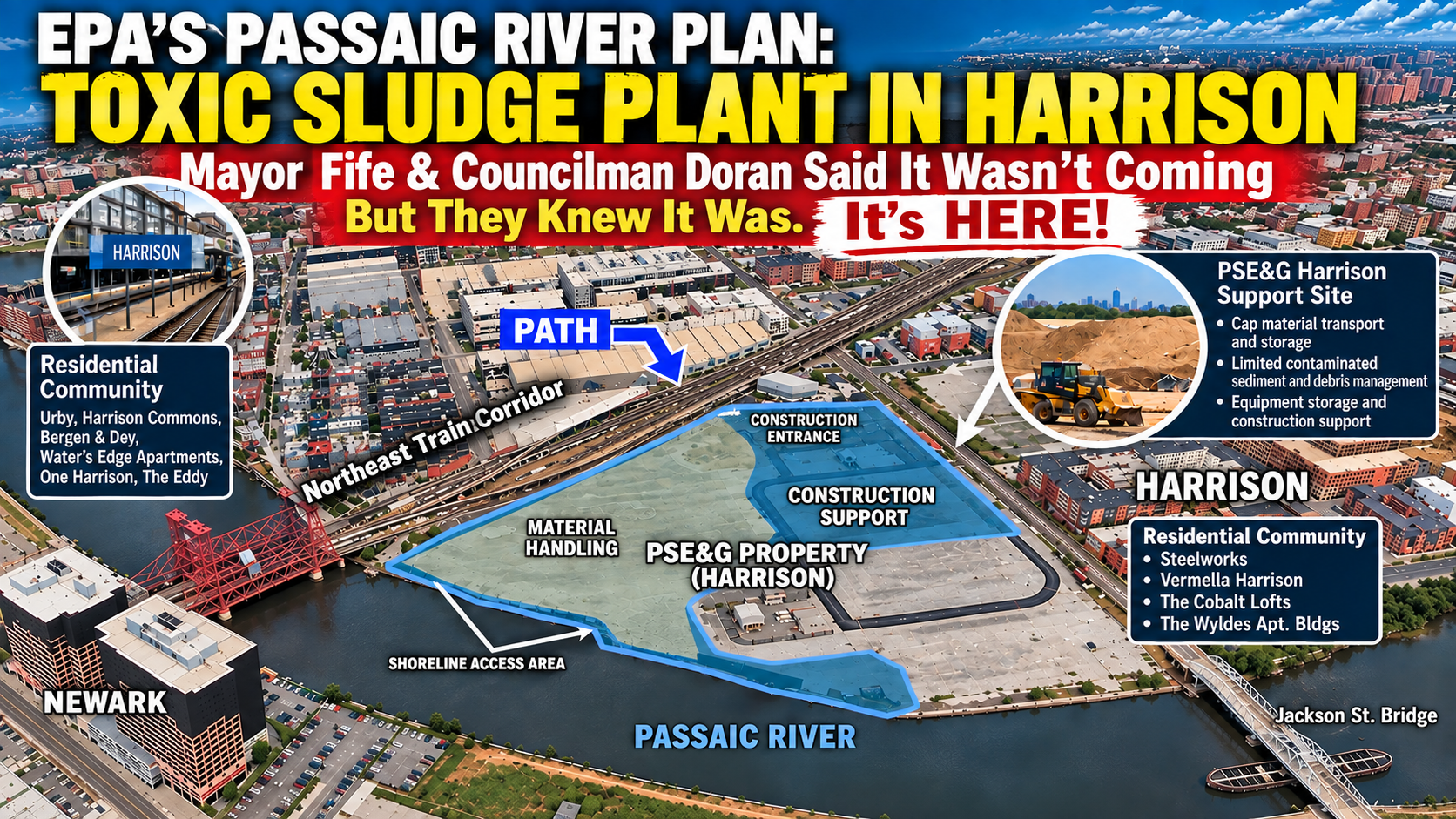
The question is whether cleaning up pollution created generations ago should require bringing contaminated sediment and the industrial operations associated with handling it onto land beside Harrison's residential community.
The Passaic River's Contamination Is Severe
There is no dispute that the Lower Passaic River is heavily contaminated. If it took
The Diamond Alkali Superfund Site includes the former chemical manufacturing property at 80 and 120 Lister Avenue in Newark, the Lower Passaic River and Newark Bay.
Diamond Alkali manufactured chemicals at the Newark property from 1951 through 1969, including DDT and other products. One byproduct was 2,3,7,8-TCDD, which EPA identifies as the most toxic form of dioxin. The consent decree states that this dioxin was released into the Passaic River.
EPA likewise describes 2,3,7,8-TCDD as an extremely toxic form of dioxin. Sampling has identified not only dioxin but also PCBs, PAHs, DDT and its breakdown products, dieldrin, mercury, copper, lead and other hazardous substances in Lower Passaic River sediment. EPA has sent general notice letters to more than 100 potentially responsible parties. Of particular significance to Harrison, an EPA document states that sediment coring found the Harrison Reach to contain the most concentrated inventory of dioxin-contaminated sediment, with a maximum detected concentration of 5,300 parts per billion of TCDD at River Mile 3.4.
Those are not ordinary river sediments. They are sediments containing some of the very contaminants that placed the Lower Passaic within the federal Superfund program.
Cleaning the River Means Disturbing the Sediment
One aspect of the project deserves more attention in Harrison: much of this contamination is presently located in the riverbed. EPA admits that in its present location it is not toxic to the public unless you eat the fish and crabs from the Passaic River. Nobody we know does that. At one meeting, an EPA representative did not know rowing crews used the Passaic River. After being asked whether rowing crews would be banned from using the Passaic River and/or whether the disruption of encapsulating sludge at the bottom of the river would eliminate rowing altogether, the answer was surprising. It would be safe for rowing.
When pushed further about whether it would be safe if a rower fell into the river, the answer was you could fall in twice and be ok. The EPA also said the air quality at Ground Zero after 9/11 was safe to breathe. Twenty-five years later, it has been proven that the EPA lied about the air quality at Ground Zero, and several New York City administrations covered up The Truth. The parallels with the Town of Harrison elected officials covering up the proposed Harrison Toxic Sludge plant, going as far as to lie about it in writing to residents, and EPA / New York City cover-up of the poor air quality at Ground Zero are present. The bottomline is the EPA cannot be trusted.
Disturbing the encapsulated sludge releases the cancer-causing dioxins and other byproducts of the production of chemicals, including Agent Orange used in the Vietnam War.
EPA's remedy calls for dredging contaminated sediment, moving dredged material to upland facilities, removing water from it, disposing of material off-site, and capping portions of the river bottom. EPA's September 10, 2026 announcement specifically states that the proposed agreement would provide facilities to remove water and handle sediment before it is sent away for disposal.
The consent decree also provides that the OU2 and OU4 remedies involve removing sediment and barging or pumping dredged material to an upland processing facility. We know that EPA is going to use the Passaic Valley Sewerage plant in the Ironbound Section of Newark, NJ, which is one mile from a residential community. A little better than across the street as it is in Harrison. It’s also enclosed, whereas the Harrison plant is open-air.
That distinction is central to the concerns being raised in Harrison. Contamination that has remained within river sediment for decades would now be physically disturbed, dredged, transferred, and handled as part of a major industrial construction project.
EPA maintains that the cleanup can be performed safely, and its design incorporates engineering controls and monitoring. But the very existence of those controls shows that dredging and handling contaminated sediment requires precautions that are not necessary when that material remains undisturbed at the bottom of the Passaic River.
EPA Has Previously Discussed the Difference Between River Contact and Sediment Exposure
At community meetings concerning the cleanup, EPA representatives have attempted to distinguish between ordinary recreational contact with Passaic River water and exposure associated with contaminated sediment.
That distinction is important for Harrison residents. For example, someone who accidentally falls into the Passaic River. For example, a rower or other recreational user may not experience the same exposure as someone who eats contaminated fish or comes into direct contact with highly contaminated sediment.
For decades, the main human-health restriction has concerned the river's fish and shellfish. New Jersey prohibits consuming fish or shellfish from the Lower Passaic River and Newark Bay, and EPA notes that fishing and crabbing advisories have been in place since the 1980s.
That reality raises an uncomfortable question about the practical benefit being offered to Harrison residents.
The average Harrison family is not waiting for the day when it can catch dinner from the Lower Passaic River. Given the history and extent of contamination, it is difficult to imagine residents suddenly treating the river as a food source merely because the dredging and capping project has been completed.
Yet residents could be asked to accept decades of construction and contaminated-sediment handling where they live. EPA has put on blinders and ignores the fact that the southern part of Harrison that helped the United States of America win World War II with its industry is still the contaminated industrial part of Harrison it was in the 1980s. It is no longer contaminated and is now a vibrant residential community that generates $ 17 million each year and growing, which gives the Town of Harrison and its elected officials matches the money it raises from property taxes. In other words, the Redevelopment Zone doubles the money the Town of Harrison used to have. Stop a moment and think: why would Harrison’s Mayor James Fife and Councilman & Passaic Valley Sewerage Commission Commissioner James Doran invite a Toxic Sludge Plant across the street from such a successful community?
Dioxin on the River Bottom Versus Dioxin Brought Onto Land
This is where the Harrison debate becomes considerably different from EPA's broader description of the cleanup.
When highly contaminated sediment remains buried or deposited in the river bottom, pathways for exposure are different than when the sediment is dredged, transferred through equipment, separated from water, stockpiled, sorted, or otherwise handled on land.
That does not mean every dredging operation necessarily releases dangerous quantities of dioxin into the air. It does mean that airborne particulate exposure is a legitimate issue that requires monitoring and control, particularly when the material contains a known carcinogenic contaminant such as 2,3,7,8-TCDD. EPA's own cleanup documents recognize that fact.
The consent decree requires baseline air-quality, odor, and noise monitoring before construction begins so that construction-related impacts can be detected when work is underway.
It also discusses restrictions intended to prevent human exposure to contaminants in soil and groundwater and specifically references new construction that could increase the risk of inhaling contaminants. EPA's May 2024 community update says its cleanup design includes a Community Health and Safety Plan addressing impacts to air quality and odors, noise and lighting, and road and river traffic. Those safeguards are important.
But they also reinforce why Harrison residents are justified in asking what happens when microscopic particles from contaminated material are generated during handling, what contaminants will be monitored in the air, where monitors will be located, what concentrations will trigger corrective action, and whether work must immediately stop when specified limits are exceeded. Is there even enough time to detect and warn when the distance from detection and warning is merely the distance of crossing the street named after the late Harrison Mayor Frank E. Rodgers.
EPA says it’s a necessary, money-saving measure because the Passaic Valley Sewerage Commission sludge plant can’t take the sludge destined for the PSE&G property in Harrison, NJ. EPA plans to vacumn up into a covered barge the sludge from the bottom of the Passaic River. But the sludge brought onto land in Harrison isn't vacuumed into a covered barge; it's dredged with a claw in the open air, then dewatered and mixed with Portland Cement for transport. It can’t be transported without being solidified because it’s so toxic that if it were transported in its wet form and there was an accident, it would contaminate the area where it seeped into. Don’t worry. In Harrison, NJ, the sludge is safe across the street from a residential community. So it's clear; let us repeat: EPA lied about the air quality at Ground Zero after 9/11.
NAPL-Contaminated Sediment Presents Another Problem
The Harrison support facilities may also involve sediment contaminated with what EPA has described as an oily substance.
EPA's May 2024 community update states that support locations in Newark, Harrison, East Newark and Kearny could be used to store construction materials and equipment, sort debris and manage some sediment contaminated with an oily substance that cannot be processed at the principal sediment processing facility.
That substance has been discussed during the cleanup process in connection with NAPL — non-aqueous phase liquid contamination.
For Harrison residents, that distinction is particularly important.The Harrison properties are sometimes described simply as "support facilities," which can sound like little more than locations for trailers, equipment and clean capping material.
EPA's own description demonstrates that the potential activities can go beyond simple equipment storage. They may involve management of debris and contaminated sediment that presents special processing problems.
The Main Processing Facility Is in Newark — But Harrison Is Handling The Worse Toxic Sludge
There is an important technical distinction that should be clearly understood. Under the present design, the principal Upland Processing Facility, or UPF, is to be built at the Passaic Valley Sewerage Commission property in the Ironboud Sectin of Newark NJ. Located one mile from a Residential Community but also in a Flood Zone.
The proposed consent decree defines the PVSC property as the site for the principal processing facility, a support facility and a resuspension-monitoring station.
The former PSE&G property in Harrison is formally identified as an Upland Support Facility, rather than the principal UPF.
That distinction should not be used to minimize the concerns of Harrison residents. A facility does not become harmless merely because EPA calls it a "support facility." The real question is what will actually happen at the Harison Toxic Sludge plant.
If contaminated sediment, NAPL-contaminated material or debris from the Passaic River will be brought onto or managed at the PSE&G Harrison property, residents deserve to know exactly how much material will be handled, how long it will remain there and how exposure will be prevented. We know that a claw will bring the NAPL Dioxin Laden Sludge from the Passaic River and place it on land at the PSE&G property in an open sludge plant where it will be dewatered, mixed with Portland Cement, dried and then transported to still unnamed landfills in the USA and Canada. The proposed Harrison Toxic Sludge plant will be across the street (So. Frank E. Rodgers Blvd) from modern residential apartment buildings and next to other residential communities north and west of the plant and next to the Harrison PATH station and the Northeast Rail lines for Amtrak and NJ Transit. Let’s not forget the Sports Illustrated Stadium (formerly Red Bull Stadium) in in the community.
This Is No Longer the Harrison of 30 Years Ago
The location also cannot reasonably be evaluated as though Harrison remains the heavily industrialized community it once was.
Harrison was historically known as the "Beehive of Industry." Factories, railroad facilities, industrial plants and the former manufactured-gas operation occupied much of the southern end of town.
Over approximately the last three decades, however, Harrison deliberately adopted a very different redevelopment strategy.The area surrounding the PATH station has been transformed into a high-density, transit-oriented residential neighborhood.
Thousands of residents now live in apartment developments including Steel Works, Vermella Harrison, Cobalt Lofts, The Wyldes Harrison and other redevelopment projects.
Some of those residential buildings are across the street from, or separated only by railroad rights-of-way from, the proposed PSE&G support-facility property.
Thousands of additional people pass through the Harrison PATH station every weekday. Sports Illustrated Stadium brings still more visitors into the immediate area for New York Red Bulls matches, Gotham FC games, international soccer, concerts and other events.
A location that may appear suitable when viewed only as a former industrial property looks considerably different when viewed in the context of the neighborhood Harrison has actually built around it. Further, the PSE&G property is no longer contaminated. PSE&G spent a reported $367 to $400 million in its clean up. Contrast that with the proposed $125 million announced in the settlement of litigation between EPA and Environmental Resource Holdings LLC. Current Mayor of Harrison James Dorn stated at a Harrison Redevelopment Agency meeting that the town planned development at the PSE&G property but it would be held up by EPA for 10 years. The actual time EPA will hold up the property depending on who you ask at EPA is between 10, 20 or 30 years after which it will need to be cleaned up from its use as a Toxic Sludge plant. PSE&G did the right thing, it cleaned up its property. PSE&G reward is its $367 to $400 million dollar clean up got them qualified to be an EPA Upland Support Facility to host the worse of the Passaic River’s toxic sludge.
EPA's Regional Cleanup Goal Could Become Harrison's Local Burden
EPA naturally views the Passaic River project on a regional scale. Harrison residents experience it on a neighborhood scale.
From EPA's perspective, there are 17 miles of contaminated river, multiple communities, more than 100 potentially responsible parties and an enormous Superfund project that must be engineered and completed.
From the perspective of someone living in an apartment near the Harrison PATH station, however, the concern is much more immediate:
What exactly will be happening across the street from my home?
Will contaminated sediment come onto the property?
Will material containing NAPL be handled there?
Could contaminated dust or microscopic particles become airborne, breathed in and cause cancer?
How will odors be controlled and will be in the air?
What happens during a power failure?
What happens during an extreme storm?
What happens if the Passaic River floods the neighborhood?
Why is the flooding at the proposed Toxic Sludge Plant not being fixed?
What happens if monitoring detects dioxin or other contaminants outside expected boundaries?
Who has authority to shut the operation down?
Does locating the Toxic Sludge Plant across the street from a residential community make any sense?
And will residents receive monitoring results immediately — or weeks or months later?
Those are not anti-environmental questions. They are precisely the questions that should be answered before hazardous material is handled close to their homes.
Recent Flooding Makes the Location Question More Serious
Flooding has become another concern surrounding the Harrison location.
The Redevelopment Zone around the PATH station has experienced significant stormwater flooding, including water emerging from sewer and drainage infrastructure near the station.
That gives the community another reason to demand detailed information about the engineering design.
The PSE&G property is along the Passaic River and close to a low-lying transportation and residential district. It is in a Flood Zone and has flooded in the past.
If contaminated sediment or debris is to be stored or handled there, EPA should publicly explain what happens during an extreme rainfall event, a river flood, storm surge, drainage failure or other emergency.
Containment systems designed for ordinary operating conditions are only part of the answer. Residents need to know what happens during extraordinary conditions.
EPA’s motto is “to protect human health and the environment”. The placement of a Toxic Sludge Plant at PSE&G violates EPA’s motto. It neither protects human health or the environment. It actually puts human health in jeopardy and does not protect the environment. You can’t trade human health for saving money. Why else would EPA seek to use the PSE&G property given that it is no longer located in an Industrial zone but a vibrant residential zone.
What Exactly Does Harrison Get in Return?
EPA regularly describes the project in terms of restoring and cleaning the Lower Passaic River. Harrison residents are entitled to look at that claimed benefit more critically.
New Jersey already prohibits eating fish and shellfish from the Lower Passaic River and Newark Bay because of contamination. EPA says fisheries have long been closed and consumption restrictions remain in effect.
It therefore strains credibility to suggest that the average Harrison resident will soon be enjoying locally caught Passaic River fish as a practical benefit of this project.
For Harrison, the tradeoff is far more complicated. The potential long-term regional environmental benefits are being weighed against immediate and localized burdens: industrial operations, contaminated-sediment handling, construction, noise, traffic, possible odors, flood concerns and questions regarding airborne particulates — all beside a neighborhood containing thousands of residents. If tenants leave the modern apartment buildlings, across the street and down the road, the Town of Harrison will lose PILOT revenue and the Harrison Redevelopment Zone will be available for its former industrial contaminated properties.
That balance deserves much more scrutiny than the phrase "cleaning up the river" suggests.
Harrison's $17 Million-and-Growing PILOT Economy
There is another issue that has received far less attention: money.
Harrison has spent nearly three decades encouraging developers to invest hundreds of millions of dollars in the southern Redevelopment Zone.
Many of those redevelopment projects operate under long-term tax-abatement agreements that provide the Town with Payments in Lieu of Taxes, or PILOTs.
Those payments now bring Harrison approximately $17 million annually, with the amount expected to grow as additional redevelopment projects are completed and occupied.
The Town's own financial website publishes its adopted budgets, user-friendly budgets, annual financial statements, audits and debt statements, underscoring the important role redevelopment-related revenues now play in municipal finances.
That creates a fundamental contradiction.
For decades, Harrison has marketed the southern end of town as a desirable residential neighborhood with immediate PATH access to Manhattan and Newark.
Developers built accordingly. Residents moved in accordingly.
And Harrison structured an increasingly important portion of its municipal revenue around the continued success of that redevelopment.
Now EPA proposes to incorporate waterfront property in that same district into a massive contaminated-river remediation project.
Could the EPA Project Put PILOT Revenue at Risk?
There is currently no evidence establishing that Harrison will lose $17 million in PILOT revenue because of the EPA project. That should not be claimed.
But it would be equally irresponsible to pretend there is no potential economic issue. Residential development depends heavily upon perception.
If prospective tenants believe they will be living beside an industrial operation handling dioxin-contaminated and NAPL-contaminated river sediment, some may choose to rent elsewhere.
If apartment demand weakens, occupancy and rental growth may be affected. If investors view the redevelopment district as less desirable, future construction could slow. In worse case scenarios, developers will abandon upkeep of apartment buildings if they cannot generate enough money to pay off mortgages on their properties.
New construction will slow, future PILOT growth could slow with it.
The question is therefore not whether Harrison's existing $17 million suddenly disappears when EPA begins work.
The question is whether EPA has conducted a serious economic-impact analysis addressing what placing this operation beside Harrison's Redevelopment Zone could mean to the enormous public and private investment that has been made there.
So far, that analysis has not been identified in the proposed consent decree.
Harrison Has Spent Decades Escaping Its Industrial Past
There is something particularly ironic about the proposal.
For most of the twentieth century, Harrison lived with the environmental and economic consequences of heavy industry.
The southern end of the community contained factories and industrial facilities rather than apartments.
Redevelopment was supposed to change that.Almost 30 years of planning, construction, infrastructure investment and tax agreements have produced a new neighborhood around the PATH station.
The Town's financial future is now tied, at least in significant part, to that transformation. The current Mayor of Harrison James Fife admitted that the Town of Harrison’s success has nothing to do with him but with what the late Mayor of Harrison Raymond J. McDonough and his then Council including late Councilman Peter Higgins, former Councilman Anselmo Millan and current Councilman Michael Dolaghan put into motion over 30 years ago.
Putting a major contaminated-river support operation into that same neighborhood risks moving Harrison backward, from a residential redevelopment district toward an industrial cleanup zone.
Harrison Residents Did Not Create This Pollution
Another issue of basic fairness cannot be ignored.
The people now living in Harrison's Redevelopment Zone did not manufacture the chemicals responsible for contaminating the Passaic River generations ago.
They did not dump dioxin into the river. They did not create the PCBs, pesticides, mercury and other contamination now embedded in the sediment.
The consent decree traces releases from the former Diamond Alkali operation and notes that EPA has identified more than 100 potentially responsible parties.
EPA itself has repeatedly emphasized the Superfund principle that responsible parties, rather than taxpayers, should pay for contamination they caused.
If polluters are being required to pay for the cleanup, Harrison residents can reasonably ask why they should nevertheless be required to shoulder a concentrated share of its physical burden. The amount of the proposed settlement is also questionable. The clean up of the PSE&G property cost $360 to $420 million dollars so the amount to settle the litigation against the responsible parties seems totally inadequate and subject to failure. What will happen then?
Why Isn’t EPA Building A State of the Art Facility in Industrial South Kearny
That question becomes particularly important because other locations exist. The PVSC property across the Passaic River in Newark is already designated for the principal Upland Processing Facility.
EPA's design also identified multiple possible support-facility sites rather than only Harrison. Harrison residents therefore deserve a detailed comparative explanation.
Why is the PSE&G Harrison site necessary?
What specific activity must happen there?
Could it happen at PVSC?
Could it happen in South Kearny or another industrial location farther from dense residential development?
What additional cost would relocation create?
How was that cost weighed against the possible health, quality-of-life and economic consequences for Harrison?
Those questions should be answered publicly and with supporting engineering and economic data.
Monitoring Is Important — But Monitoring Does Not Eliminate Risk
EPA emphasizes monitoring and safety controls.
Those safeguards are necessary, but Harrison residents may reasonably ask whether monitoring a problem is the same as avoiding it.
Air monitors can detect changes in conditions. They cannot make a residential apartment building farther away from an industrial operation.
Emergency plans can describe what to do after something goes wrong. They cannot eliminate every possibility of an accident.
Flood-control measures can reduce risk, but are they even in the plans? EPA says the contractor designated to build the plant will design the plant. So, EPA doesn’t have anything to do with the plant?
They cannot prevent every extreme weather event. The best way to reduce exposure to a hazardous operation is still, where feasible, to place that operation farther away from large numbers of people.
That basic principle should be part of EPA's location analysis.
The Agreement Is Still Subject to Public Comment
The proposed consent decree has not simply disappeared into the federal bureaucracy as a completed decision.
The decree states that it must be lodged with the federal court for at least 30 days for public notice and comment. The United States may withdraw or withhold its consent if public comments disclose facts or considerations showing that the agreement is inappropriate, improper, or inadequate. The deadline for emailing and/or mailing in time is 10/15/2026. The proposed consent decree was published on 9/15/2026.
The email address is [email protected], and the mailing address is
Assistant Attorney General
U.S. DOJ—ENRD
P.O. Box 7611
Washington, D.C. 20044–7611
Email delivery is preferred.
That gives Harrison residents an important opportunity. Comments should not be limited to whether polluters should pay for the Passaic River cleanup.
They should address where the work will occur and who will bear its consequences.
Residents, apartment owners, developers, commuters, and Harrison officials should consider demanding answers concerning air monitoring, NAPL-contaminated sediment, flooding, material handling, truck and rail movement, operating hours, emergency shutdown procedures, and economic impacts on the Redevelopment Zone.
Cleaning the River Should Not Mean Moving Its Pollution Into Harrison
The history of the Lower Passaic River is unquestionably a history of industrial contamination.
But Harrison residents did not create that contamination, and the residential community surrounding the PATH station should not automatically become the place where the consequences of generations-old pollution are transferred from the river bottom onto land.
The sediment EPA intends to dredge contains dioxin, PCBs, mercury, pesticides, and other hazardous substances.
EPA's own documents recognize the need for air monitoring, exposure controls, environmental safeguards, and special management of some oily contaminated sediment.
Harrison therefore does not have to accept the false choice between supporting or opposing cleaning the Passaic River.
The Town and its residents can support making polluters responsible for their contamination while simultaneously insisting that contaminated sediment be handled at locations that do not unnecessarily place thousands of residents, a major transportation hub and nearly three decades of public and private redevelopment investment next to the operation.
The central question for Harrison is not whether the Passaic River should remain polluted.
It is this:
Does cleaning up someone else's pollution require bringing that pollution onto land beside Harrison residents?
Before that happens, EPA should be required to demonstrate publicly, scientifically, and convincingly why Harrison is the appropriate place to accept that risk — and why less populated, more industrial alternatives cannot be used instead.
Your Harrison Is Your Community — Join the Conversation
Local news is better when the community is part of it. After reading this article, tell your neighbors what you think, share information, ask questions, or start a discussion on the Community Discussion Board.
Not a member yet? Joining Your Harrison is free. Become part of a growing community of residents, former residents, local business owners, and others who care about what is happening in Harrison and West Hudson.
Join Your Harrison FREE today, then make your voice part of the conversation.
Submit An Article