Election Officials' Mistake Reveals New Election Statute Is Flawed
Jul 20, 2026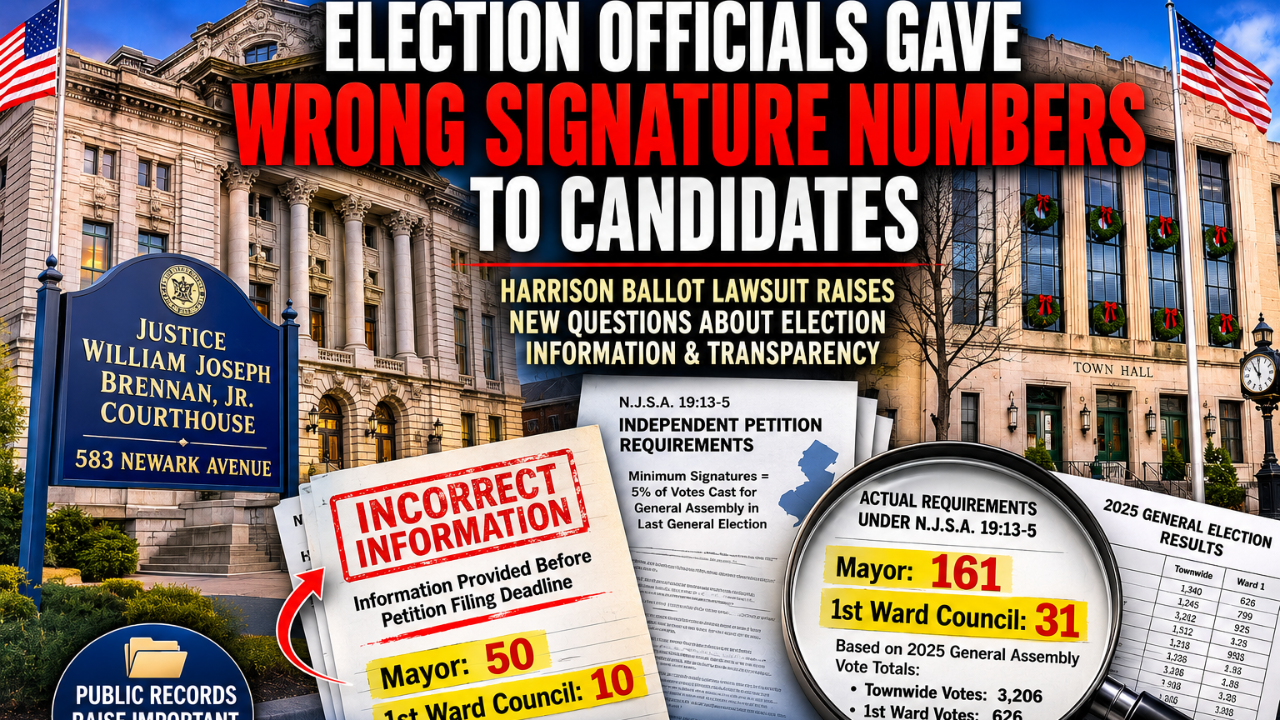
If an election official gives you false or inaccurate information on signature minimums for a Petition, should that same election official be allowed to reject your Petition because it fails to meet the number of signatures that are more than the candidates were told were necessaty to get on the ballot? That is the central issue in cases filed by two Harrison residents seeking elected office.
Public records, court filings, and election documents leave unanswered questions about the information available to candidates before petition filing deadlines. Two election lawsuits have brought renewed attention to an issue extending beyond the candidacies of Harrison mayoral candidate Dominick Ritorto and First Ward council candidate Michael Verile: How was the minimum number of signatures required to run for office determined, and could an ordinary citizen have independently calculated that number using publicly available information before the filing deadline?
The Ritorto & Verile Complaints requesting to be returned to the November General Election Ballot are the result of Harrison Mayor James Fife and Councilman Jesus Huaranga's request to remove Ritorto & Verile from the ballot for inadequate signatures on their Petitions to Run For Elected Office. Ritorto & Verille contend they relied on inaccurate minimum signature information that originated from election officials; the same information was also given to YourHarrison.com and published in an article entitled How To Run In November For Harrison NJ Mayor or Council.
Both the Hudson County Clerk and the Harrison Town Clerk's offices, and YourHarrison.com provided the same inaccurate minimum signature requirement, which gave the candidates the belief that they had accurate information. YourHarrison.com received the information in writing in an email from the Supervisor of Elections for the Hudson County Clerk's office after an inquiry in preparation for its article.
Ritorto & Verile filed their Complaint to be returned to the ballot and attached the Hudson County Clerk's office email to YourHarrison.com. The Candidates would have had enough signatures to get on the ballot if the County Clerk's offices and/or the Court had honored the incorrect minimum number of signatures. The Appellate Division in a similar case reversed a lower court and returned the candidates to the ballot.
A Formula That Appears Simple BUT Is Not
A 2025 New Jersey law requires Independent Candidates seeking placement on the General Election ballot to submit signatures equal to five percent of the total vote cast for members of the General Assembly in the last preceding General Election for the district or political subdivision in which the office is sought. On its face, the statute appears straightforward. The challenge, however, is determining the underlying vote totals needed to perform the calculation.
In the Harrison litigation, Mayor James Fife, First Ward Councilman Jesus Huaranga and the Harrison Regular Democratic Committee, represented by the law firm of Castano Quigley Cherami LLC, asserted that the 2025 General Assembly turnout in Harrison totaled 3,206 votes townwide and 626 votes in the First Ward, producing minimum signature requirements of 161 signatures for Mayor and 31 signatures for First Ward Council. Castano Quigley Cherami LLC is also the Town of Harrison Attorney and the Harrison Redevelopment Agency Attorney.
The Harrison litigation has also highlighted another aspect of New Jersey election law that may surprise many voters. For the 2026 Primary Election, candidates seeking the Democratic or Republican nomination for Mayor of Harrison were required to obtain a minimum of 50 signatures, while candidates seeking nomination for a Town Council seat were required to obtain a minimum of 25 signatures, subject to the statutory provisions governing partisan petitions. These requirements are established under New Jersey's Primary Election statutes.
Independent Candidates Need More Signatures Than Primary Candidates
For the 2026 General Election, however, independent candidates were required to satisfy a different statutory formula under N.J.S.A. 19:13-5, which requires signatures equal to five percent of the votes cast for members of the General Assembly in the last General Election. The Hudson County Clerk and the Harrison Town Clerk’s office calculated the numbers incorrectly. Here is a comparison of the minimum number of signatures for the Primary, General Election, and those provided by the Clerks and provided to YourHarrison.com:
|
Office |
2026 Primary Election |
2026 General Election |
Hudson County Clerk Minimum Signature Numbers (Incorrect) |
|
Mayor of Harrison |
50 |
161 |
25 |
|
Councilman 1st Ward |
25 |
31 |
10 |
As a result, an Independent Candidate for Mayor in Harrison was required to obtain more than three times as many signatures as a Democratic or Republican candidate seeking that party's nomination
Likewise, an Independent Candidate for First Ward Council was required to obtain 31 signatures for the General Election compared with 25 signatures for a candidate seeking a party nomination in the Primary Election.
Inaccurate Information Provided
The Hudson County Clerk stated you needed 25 signatures for Mayor and 10 signatures for 1st Ward Council. Given the Primary numbers of 50 for Mayor and 25 for 1st Ward Council, a candidate and a local news website owner would not have any suspicion that the official numbers were inaccurate/ false.
Those differences are the result of two separate statutory schemes enacted by the Legislature. The Court was not asked to address the constitutional issue raised by the different number of votes required in a Primary versus the General Election, but maybe it should have addressed it as part of the pending litigation. Nevertheless, the disparity illustrates why accurately determining the applicable signature requirement is critically important to prospective candidates and why the source of that inaccurate information has become a central issue in the Harrison ballot-access dispute.
Hudson County’s Supervisor of Elections, Ambar Vargas, who provided the inaccurate/false minimum signature requirements, has tried to exculpate herself from her mistake by stating “it’s not the responsibility of the clerk’s office” to provide signature guidance to candidates in an earlier case. Vargas was not called to testify in this latest case.
Vargas’ minimum signature requirements were later incorporated into the parties' Stipulation of Facts, thus establishing that Vargas did provide inaccurate/false minimum signature numbers.
The Information Candidates Say They Received
Court exhibits include an email from the Harrison Town Clerk's Office responding to a March 23, 2026 inquiry from a candidate asking whether the same petition requirements applied to both primary and independent candidates. The response stated: "Yes - you are correct. You do need the petition for both."
The litigation also includes email chains and stipulations concerning communications from the Hudson County Clerk's Office regarding signature requirements before petitions were filed. The plaintiffs contend those communications, together with information later published in an article by YourHarrison, led them to believe the required signature totals were substantially lower than those ultimately applied by the Hudson County Clerk. The parties' stipulations acknowledge that the YourHarrison article was published before the petition filing deadline and that the plaintiffs read it before filing their petitions, while reserving the plaintiffs' contention that they also relied on information received directly from county and municipal election officials. It all matched up, and thus they had no reason to believe it was inaccurate.
The County Clerk's Position
Hudson County's legal position is markedly different. In its opposition papers, the County argues that the signature requirement is fixed by statute and that the necessary election data was publicly available. According to the County, candidates bear the responsibility of determining the correct number of signatures, and the Clerk's Office has no legal duty to provide legal advice regarding statutory requirements.
The County further argues that the 2025 vote totals were publicly accessible and that the 5% calculation was "objectively calculable" from those official election results. Counsel for Mayor Fife and Councilman Jesus Huranga attached as Exhibit C to their Motion to Dismiss Candidate Ritorto and Verile’s Petitions for Mayor & Council, respectively, ten pages (pages 269 to 278) of a Document entitled “Results by Municipality Ward and District. Official Results” related to the November 4, 2025 Election. The document is partially available on the Hudson County Clerk’s website but ends at page 41. A search of the Hudson County Clerk’s office website and the internet only produced a truncated Official Results 41-page document.
At the time of publication, however, YourHarrison had not been able to independently verify that the larger document was publicly available online before the June 2, 2026 petition filing deadline.
Why That Matters
For election attorneys and government officials familiar with New Jersey election law, calculating the statutory minimum may be relatively straightforward once the underlying vote totals are known. For members of the public considering a first run for office, however, the process may not be as obvious.
The statute itself provides only the mathematical formula. It does not identify where a prospective candidate should obtain the precise vote totals needed to perform the calculation. That distinction lies at the center of the pending litigation.
If the underlying election data was readily available before the filing deadline, the County argues candidates had the responsibility to determine the correct number themselves.
If the necessary information was difficult to locate, or if candidates were affirmatively given incorrect information by election officials, that raises separate questions concerning transparency, reliance, and the administration of elections.
A Document That Raises Additional Questions

The significance of the latter statement is that there was no way to determine online how many voters came out to the 2025 General Election for General Assembly when Hudson County didn’t publish those numbers online. Somehow, Mayor Fife’s counsel obtained the full document produced by the Hudson County Clerk’s office, but only a partial document was made available to the public. We could be mistaken, and the document was published and not picked up by the search engines or Artificial Intelligence bots that search the web for information. The Candidates can’t be faulted for not looking long enough since they had two different clerks (Hudson & Harrison) advise them of the same minimum signature requirement and an article stating the exact same numbers.
Plaintiffs Cite New Jersey's Tradition of Ballot Access
The plaintiffs' trial brief presents a different legal theory. Their attorney, Michael Collins of King Moench & Collins LLC, argued that New Jersey election laws have long been interpreted liberally to maximize voter participation and ballot access, citing New Jersey Supreme Court decisions emphasizing that technical mistakes should not unnecessarily deprive voters of choices at the ballot box.
2021 Appellate Division Case Finds Erroneous Guidance Warrants Placement On Ballot
The brief also relies on a 2021 Appellate Division decision in Fuhrman v. Mailander, 466 NJ. Super. 572 (App. Div. 2021), where a petition was allowed to proceed after petitioners relied upon erroneous guidance from a municipal clerk concerning signature requirements. The plaintiffs contend that the same equitable principles should apply where election officials supplied incorrect information regarding petition signatures. This case apparently was not followed by the Court.
Trial Court Dismissed the Lawsuits
Hudson County Assignment Judge David Katz ultimately dismissed the lawsuits. According to reporting by David Wildstein of the New Jersey Globe News, Judge Katz concluded that the candidates failed to obtain the required number of signatures and also were three days late in filing their court challenges within the statutory deadline established by N.J.S.A. 19:13-12. The judge further concluded that candidates ultimately bear responsibility for determining the legal requirements governing ballot access even if they receive inaccurate minimum signature numbers from County & Municipal Clerks (election officials). Per New Jersey Globe News, the candidates were considering an appeal of the decision. Mayor Fife & Councilman Huaranga's counsel never gave notice to Candidates Ritorto & Verile as required by the deadline statute, but the court apparently did not apply that requirement strictly under the facts of this case.
We encourage you to share your thoughts on the Community Discussion Board after reading this article.
For those not yet registered, participation is free and open to anyone who wants to stay engaged with Harrison’s local events, businesses, and community conversations. It's a Free Membership. Sign up today and be part of the conversation.
Submit An Article